
How to Use Straps for Deadlift

If your grip is giving out before your legs and back do, you're leaving reps on the table. Lifting straps for the deadlift are not a crutch. Used correctly, they're a tool that lets you train the muscles you're actually trying to train.
Here's exactly how to use straps for deadlift, when to put them on, and what mistakes to avoid.
Why Deadlift Straps Exist
Your grip has a ceiling. For most people, the forearms and hands fatigue faster than the posterior chain: the glutes, hamstrings, and erectors that the deadlift is supposed to hammer. When grip failure cuts your set short, those bigger muscles don't get the stimulus they need.
Lifting straps wrap around the bar and your wrists, effectively connecting your hands to the barbell so the load transfers up your forearms and into your upper arms rather than hanging purely from your fingers. The result: your posterior chain keeps working past the point where bare grip would fail.
This matters most during heavy accessory volume: Romanian deadlifts, rack pulls, deficit pulls, and high-rep conventional work. It matters less for your top-set competition pull, where grip training has value and you want to build the real thing.
How to Wrap Lifting Straps for Deadlift
Most people wrap their straps wrong, which either kills their grip security or restricts their wrist. Here's the correct sequence:
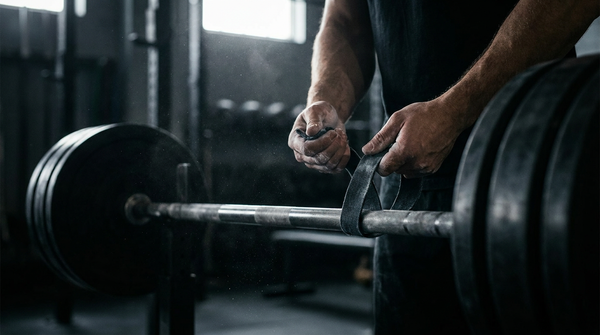
- Thread the strap through itself to create a loop. Slide your hand through the loop so the tail of the strap exits toward the pinky side of your palm.
- Position the loop snug around your wrist, right at the wrist joint. Not at the base of your thumb, not loose at the middle of your forearm.
- Place your palm on the bar. The tail of the strap should lie across the bar, on the side away from you.
- Roll the bar toward you. As the bar rolls, the strap wraps around it. One full wrap is usually enough. Two wraps add more security but slow your setup.
- Grip the bar and the wrapped strap together. Squeeze hard. Your hand now acts as the anchor point, not the sole load carrier.
It takes a couple of sessions to get fast at this. The wrap should feel tight but not cut off circulation. If your hands go numb, re-thread and give yourself slightly more loop room.
For lasso-style straps (the most common type), the process above applies directly. Figure-8 straps are a different design, looping around both the bar and wrist in a fixed figure-eight pattern, and are primarily used by powerlifters for maximal single-rep pulls. For general training, lasso straps are more versatile.
When to Use Straps vs. When to Build Bare Grip
The answer depends on your training goal for that session.
Use straps when:
- You're doing high-rep accessory deadlifts (3x8 or more) and grip failure would cut the set short
- You're working deficit pulls or Romanian deadlifts where time under tension is the point
- You're in a hypertrophy phase focused on posterior chain volume, not grip development
- You've already done bare-grip work earlier in the session and grip is pre-fatigued
Train bare grip when:
- You're doing top-set pulls at moderate weight where grip is not the limiting factor
- You're specifically programming grip training (farmer carries, dead hangs, plate pinches)
- You want to test your true competition-condition strength
A practical rule: if the set is below 80% of your max, consider pulling raw first, then switching to straps for the backoff sets. Your grip will get stronger over time, and you won't sacrifice posterior chain volume while it catches up.
If you're also doing pull movements like rows or rack pulls, straps help there too. Same wrapping principle applies.
Common Mistakes When Using Deadlift Straps
Wrapping too loose. If the strap slides on the bar, you lose the mechanical advantage. Wrap tight enough that the strap bites into the knurling.
Strapping up too early in a training cycle. If you're only pulling 135 pounds, your grip can handle it. Save straps for weights that actually challenge the grip. This ensures you're building real grip strength progressively rather than bypassing it entirely.
Using the wrong strap for the job. Thin cotton straps work for light accessory volume. If you're pulling heavy, you want a thicker, padded strap that won't cut into your wrist. Battle Bunker lifting straps are built with wrist padding specifically for this. Heavy barbell work gets uncomfortable fast without it.
Forgetting hook grip as a progression tool. Hook grip, wrapping your thumb under your fingers on the bar, is an alternative to straps for competition lifters. It's painful at first but effective. Some lifters use both: hook grip for top sets, straps for volume work.
Rushing the setup. In a hurry to get under the bar, lifters rush the wrap and end up with a sloppy loop. Take 15 extra seconds. A proper setup pays off across the whole set.
Deadlift Strap Exercises Beyond the Conventional Pull
Once you're comfortable with the wrap, use straps across the full range of deadlift variations:
- Romanian Deadlift (RDL): High-rep, hamstring-focused. Straps let you focus on hip hinge mechanics without grip cutting the stretch short.
- Rack Pull: Partial range, overload-focused. These involve more weight than a full pull, so straps are standard.
- Deficit Deadlift: Pulling from a slight elevation increases range of motion. Grip fatigue accumulates faster. Straps help.
- Trap Bar Deadlift: Same wrapping process works. Handles on a trap bar are easier to wrap than a straight bar for beginners.
- Sumo Deadlift: Wider stance, more upright torso. Straps work identically. Just make sure the wrap direction is the same (bar rolling toward you).
If you're also doing rows, shrugs, and loaded carries, get comfortable wrapping quickly so transitions between exercises stay smooth.
Practical Takeaways
- Wrap the strap at your wrist joint, tail on the far side of the bar, then roll the bar toward you
- One solid wrap is usually enough for training; two wraps for maximal singles
- Use straps on high-rep accessory work; build bare grip on moderate-load top sets
- Thick, padded straps reduce wrist discomfort on heavy pulls
- Don't skip grip work entirely. Farmer carries and dead hangs keep raw grip strength developing in parallel
Straps don't make you weak. Skipping the work because you've got bad form, insufficient recovery, or are programming poorly: that makes you weak. Use straps as part of an intelligent program and your total deadlift will go up, not down.
 length: 62901 lines: 1311