
Best Outdoor Workouts: 6 High-Impact Training Sessions You Can Do Anywhere

The best outdoor workouts do more than get you sweating. They build strength, conditioning, and mental grit that translates directly to athletic performance. Whether you're training for a military fitness test, a Hyrox competition, or just trying to build a body that works in the real world, outdoor training gives you variety and challenge that a standard gym can't replicate. This guide covers the most effective outdoor workouts you can build into your routine right now.
Why Train Outdoors
There's nothing wrong with a gym. But training outdoors adds variables that a climate-controlled room removes: uneven terrain, changing conditions, heavier carries, longer distances, and the kind of sustained output that shows you exactly where your fitness stands.
Military and special operations fitness programs have relied on outdoor training since before modern gyms existed. There's a reason. The body adapts to what you actually put it through. Running on a treadmill is not the same as running on a trail. Carrying a sandbag across a parking lot is not the same as a machine press. Both have their place. Outdoor work fills the gaps.
1. Rucking
Rucking is walking or hiking with a weighted pack. It's the backbone of military conditioning and one of the best low-impact cardio tools available. Load a backpack with 20-45 lbs and cover ground at a steady pace. Four miles takes most people about an hour at a brisk walking pace.
Benefits: builds posterior chain, improves cardiovascular capacity without the joint impact of running, develops mental durability during longer efforts.
How to progress: start with 20 lbs and 2-3 miles. Add weight or distance weekly, not both at once. Once you're comfortable with 35+ lbs over 4-5 miles, you're building serious work capacity.
The Hybrid Weight Vest MK2 works well for rucking-style training when you want a more secure, balanced load than a backpack. It also frees your hands for pull-ups or carries without needing to change equipment.
2. Sprint Intervals
Short, max-effort sprints do things for your body that long steady-state cardio doesn't. They build explosive power, spike your metabolism, and improve your top-end running speed in a short window of time.
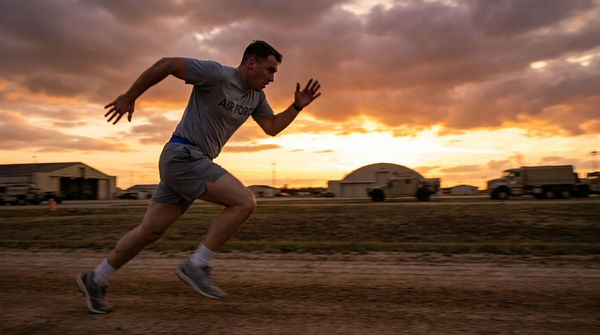
A simple protocol: find a flat stretch of turf, asphalt, or grass. Sprint 40 meters at full effort. Walk back. Rest 60-90 seconds. Repeat 8-12 times. That's your session.
Variations: hill sprints add resistance and reduce ground impact. Sled pushes (if you have access) work the same energy system with less central nervous system fatigue than flat sprints.
Do sprint work 1-2 times per week maximum. The recovery demand is real. More is not better here.
3. Bodyweight Circuit Training
A park, a flat surface, and your bodyweight is enough equipment to build real strength. Set up a circuit with compound movements and minimal rest between exercises.
A sample outdoor bodyweight circuit:
- 10 push-ups
- 15 air squats
- 10 jump squats
- 10 dips (on a bench or railing)
- 20 mountain climbers
- 10 burpees
Complete the circuit with 60 seconds rest. Repeat 3-5 rounds. Adjust reps to match your current fitness level. The goal is to keep moving with quality form, not to collapse after round one.
4. Pull-Up Bar Work Outdoors
Most parks have a pull-up bar, and if you don't have access to one, a sturdy tree branch works. Pull-up bar training outdoors lets you combine bodyweight pulling strength with the conditioning demand of an outdoor environment.
A complete pull-up bar session:
- Dead hangs: 3 x 30 seconds (grip and shoulder prep)
- Pull-ups: 5 sets to 2 reps shy of failure
- Hanging knee raises: 3 x 12
- Scapular pulls: 3 x 10
Pair hanging ab straps with your outdoor pull-up bar sessions for the hanging core work. They clip on in seconds and add a full core training component without any additional equipment.
If you're building toward pull-up volume, resistance bands can be looped over the bar to provide assistance on your weaker sets. Start there and remove band assistance as your strength improves.
5. Sandbag Training
Sandbag work belongs outdoors. It's awkward, heavy, and uncomfortable to carry, which is exactly why it builds the kind of functional strength that carries over to real physical demands.
Core sandbag movements:
Sandbag carry: Pick up the bag in a bear hug and carry it 40-50 meters. Drop it. Rest. Repeat. This is the foundation. It works your entire body and demands more from your core than nearly any gym exercise.
Sandbag clean: Drive the bag from the ground to shoulder height using your hips. The uneven load makes every rep slightly different from the last.
Sandbag shouldering: Pick the bag from the floor and get it over your shoulder. Set it down. Switch sides. This is taxing in a way that a barbell clean doesn't replicate.
Sandbag squat: Hold the bag at your chest or on your back and squat. A 60-80 lb bag squat is a serious challenge for most people.
6. Running Drills and Distance Work
Outdoor running is the most direct way to build base conditioning. But going for a jog isn't enough on its own if you want to improve. Structure matters.
Three types of outdoor running work to rotate through:
Easy distance: 30-60 minutes at a conversational pace. Builds aerobic base. You should be able to hold a conversation throughout. If you can't, slow down.
Tempo runs: 20-30 minutes at a pace that's uncomfortable but sustainable. This is the effort where you could speak a sentence but wouldn't want to. Builds lactate threshold.
Interval running: Timed efforts at high intensity with rest intervals. Example: 6 x 400 meters at hard effort with 90 seconds rest between each. Builds speed and capacity.
Rotate through these across your training week. Don't do high intensity running every day. Your body needs the low-intensity sessions to absorb the hard work.
How to Build an Outdoor Training Plan
The mistake most people make is training hard every day until they break down. Outdoor training can be intense, and that intensity needs to be managed.
A practical weekly structure for outdoor training:
Monday: Sprint intervals or bodyweight circuit
Tuesday: Easy run or ruck
Wednesday: Pull-up bar work + core (ab straps)
Thursday: Rest or light mobility work
Friday: Sandbag training or longer bodyweight circuit
Saturday: Long ruck or tempo run
Sunday: Rest
Adjust based on how you recover. If you're dragging by Thursday, add a rest day on Wednesday. Training hard on a depleted system doesn't produce results. It produces injury.
Gear That Makes Outdoor Training Better
You don't need much. The whole point of outdoor training is that it requires less equipment, not more. But a few tools make the work better:
- Weight vest: The Hybrid Weight Vest MK2 adds load to runs, pulls, and bodyweight circuits without restricting movement.
- Resistance bands: The Battle Bands 3-Pack fits in a pocket and adds resistance to warm-ups, hip work, and pull-up assistance.
- Ab straps: If your outdoor spot has a pull-up bar, hanging ab straps turn it into a full core training station.
Keep the gear list short. The point is to show up and work, not to build a portable gym.
Start This Week
Pick one workout from this list and do it tomorrow. Don't overthink it. Outdoor training rewards consistency over complexity. Show up, put in the work, and build from there. The results come from doing the work week after week, not from finding the perfect protocol before you start.