Sandbag Workout: Build Functional Strength with Unstable Load Training

A good sandbag workout will expose every weakness in your fitness that a barbell program lets you hide. The load shifts. Your grip fatigues. Your stabilizers fire constantly. The result is functional strength that carries over to real-world demands in a way that machines and fixed implements simply cannot replicate. If you have been sleeping on sandbag training, here is everything you need to start using it effectively.
Why Sandbag Training Works
A sandbag is what training scientists call an unstable load. Unlike a barbell, where the weight is fixed and predictable, a sandbag shifts during movement. The filler material moves inside the bag, constantly changing your center of gravity. Your body responds by recruiting more stabilizing muscles to compensate.
This makes sandbag training exceptionally good for:
- Building total-body strength that transfers to physical work and athletic performance
- Developing grip and forearm endurance that barbells cannot match
- Training the core in a dynamic, functional way, not just flexion and extension
- Building conditioning without requiring machines, a gym, or significant setup
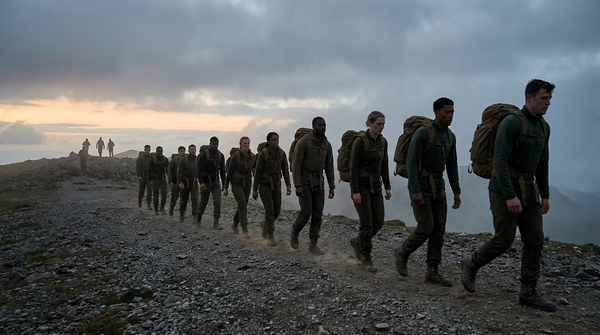
Military and tactical athletes have used sandbag training for decades because it mimics the demands of carrying gear, moving casualties, and operating under load in unpredictable terrain.
Choosing the Right Sandbag Weight
The right sandbag weight depends on what you are training for. Here is a general guide:
- 20 to 40 lbs: Best for conditioning circuits, high-rep carries, and beginners building a base. Good for running-focused hybrid athletes who want strength work without excess fatigue.
- 40 to 60 lbs: The sweet spot for most strength and conditioning combinations. Heavy enough to build real strength, light enough to sustain quality movement over a workout.
- 60 to 80 lbs: Serious strength and power development. Used for carries, throws, cleans, and squats when your goal is to build raw capacity.
The Battle Bunker Skirmish Training Sandbag covers the 20 to 40 lb range, built with durable construction and reinforced handles for a full range of movements. If you are ready to go heavier, the Raider Training Sandbag handles 60 to 80 lbs for serious strength and power sessions.
The Foundational Sandbag Movements
Before building a workout, you need to know the core movements. These are the ones worth mastering:
Sandbag Clean
Start with the sandbag between your feet in a deadlift position. Grip the handles or wrap your arms around the bag. Drive through your legs and hips, pull the bag up, and receive it at chest height in a front-rack or bear-hug position. This is a power movement. It trains your posterior chain, explosiveness, and coordination simultaneously.
Sandbag Squat
Hold the bag in a bear-hug or shoulder position. Squat to depth, keeping your chest up and your weight distributed through your full foot. The shifting weight of the bag makes your core work harder than a standard front squat to maintain position. Start light until the movement feels controlled.
Sandbag Carry
Pick up the bag and carry it. This sounds simple, but loaded carries are one of the most effective strength-building and conditioning tools in any program. You can carry it in a bear-hug, on one shoulder, or in a zercher position. Vary the carry style to target different muscles and challenge your stability differently.
Sandbag Deadlift
Set the bag on the ground between your feet. Hinge at the hips, grab the handles, and stand up. The mechanics are the same as a conventional deadlift, but the unstable load forces your lats and grip to work harder throughout the pull.
Sandbag Over-the-Shoulder Throw
Deadlift the bag and, in one explosive movement, throw it over one shoulder. This builds explosive power in the hips and posterior chain. It also takes conditioning to a different level because the intent is to move fast and hard.
Sandbag Lunge
Hold the bag at your chest or on one shoulder and lunge forward or in place. The asymmetric loading option, holding the bag on one shoulder, dramatically increases the anti-lateral-flexion demand on your core. It is a great exercise for building strength that carries over to uneven terrain and loaded movement.
A Complete Sandbag Workout
Here is a structured workout you can run with a 40 to 60 lb sandbag. Rest 60 to 90 seconds between rounds.
Warm-Up (5 minutes)
- 10 bodyweight squats
- 10 hip hinges with a light load or bodyweight
- 10 push-ups
- Arm circles and hip rotations
Round 1 through 4: Strength Circuit
- Sandbag deadlift x 8 reps
- Sandbag clean x 6 reps
- Sandbag squat x 8 reps
- Sandbag lunge (alternating) x 10 reps total
Rest 90 seconds between rounds. Focus on quality movement. The bag is going to fight you. Let it make you work harder rather than rushing through the reps.
Conditioning Finisher: Carry Complex (2 rounds)
- Bear-hug carry x 40 yards
- Right shoulder carry x 40 yards
- Left shoulder carry x 40 yards
- Set down, rest 60 seconds, repeat
Total working time is approximately 35 to 45 minutes. This session hits your posterior chain, core, grip, and cardiovascular system without a single machine.
Sandbag Training for Hybrid Athletes
If you are training for performance across multiple domains, sandbag work pairs well with running and bodyweight training. Carries in particular are a powerful bridge between strength training and aerobic conditioning. A sandbag farmer carry for 400 meters at a moderate pace will challenge your cardiovascular system in a way that resembles the demands of a ruck march or a loaded event like Hyrox.
For athletes training toward hybrid competitions or military fitness tests, building a session around sandbag carries plus running intervals is one of the most effective general fitness protocols available. Heavy carries build the hip stability and postural endurance that makes running more efficient under fatigue.
Programming Sandbag Work Into Your Week
You do not need to do sandbag training every day to see results. Two sessions per week as a standalone workout, or one heavy sandbag session alongside your regular training, is enough to drive adaptation. Here is a simple weekly structure:
- Day 1: Sandbag strength session (the circuit above)
- Day 2: Rest or active recovery
- Day 3: Carry and conditioning session (carries plus running)
- Day 4 and 5: Barbell or bodyweight training
- Day 6: Long ruck or easy aerobic session
- Day 7: Rest
If you are building toward a specific event, progressively increase the load and carry distance over eight to twelve weeks. Log your sessions so you can see measurable progress week over week.
Sandbag Training vs Barbell Training
These are not competing approaches. Sandbag training is most valuable when used alongside barbell work, not in place of it. The barbell is more efficient for building maximum strength because the load is precise and controllable. The sandbag builds the supporting qualities: grip endurance, core stability under dynamic load, and the kind of toughness that comes from wrestling with an implement that does not cooperate.
Think of it this way: the barbell makes you strong, and the sandbag makes that strength useful.
Getting Started
If you are new to sandbag training, start lighter than you think you need to. The first few sessions, the unfamiliar load position will challenge you more than the weight itself. Get comfortable with the clean and the squat before adding carries. Once you can move through the basic movements cleanly, start adding load and volume over several weeks.
The Skirmish Sandbag is the right starting point for most athletes. It is built in the USA with reinforced handles and a durable outer shell designed to hold up to outdoor training and repeated use. Once you outgrow it, the Raider Sandbag is waiting at 60 to 80 lbs.
The Bottom Line
Sandbag training builds strength you can actually use. It is brutally honest about weaknesses, it requires no gym, and it conditions your body in a way that fixed implements cannot replicate. Pick up a bag, learn the basic movements, and run the workout above twice a week for a month. The difference in your grip, core stability, and overall work capacity will be obvious.