
How to Use Straps for Deadlift: Setup, Technique, and When to Use Them

If you want to know how to use straps for deadlift, the answer is simpler than most people make it. Wrap the strap around the bar, grip it, and pull. But if you do it wrong, the strap either slips or cuts off your blood flow, and your setup costs you a rep. This guide covers exactly how to wrap lifting straps for the deadlift, when to use them, and how to get the most out of them on heavy pulls.
Why Use Straps for the Deadlift
Your grip will fail before your back and legs do. That's the reality of deadlifting at higher volumes or heavier weights. When your hands can't hold the bar through a full set, your posterior chain doesn't get the stimulus it needs. You're leaving gains on the floor.
Lifting straps bridge that gap. They transfer the load from your fingers and hands to your wrists and forearms, so the limiting factor becomes your actual pulling strength, not your grip endurance.
This isn't a crutch. It's a tool. Powerlifters, strongmen, Olympic weightlifters, and military athletes all use straps in training. The goal is to load the target muscles hard enough to create adaptation. Straps let you do that.
Types of Lifting Straps for Deadlift
There are three main styles. Knowing the difference matters before you buy.
Loop Straps
A simple closed loop. Your wrist goes through the loop, then you wrap the tail around the bar. These are the most common style. They're fast to put on, durable, and work for deadlifts, rows, and rack pulls. The Battle Straps Weightlifting Straps use this design with heavy padding and reinforced stitching built for high-rep pulling work.
Figure-8 Straps
The strap goes through your hand twice, forming a figure-8 pattern around the bar and your wrist. Extremely secure. Commonly used in strongman for max effort pulls. The downside: they're slower to get on and off, which can be awkward between sets.
Lasso Straps
An open-ended strap that wraps around the wrist and then the bar in a lasso motion. Similar to loop straps with a slightly different wrap pattern. Most interchangeable with standard loop straps in terms of performance.
How to Wrap Lifting Straps for the Deadlift: Step by Step
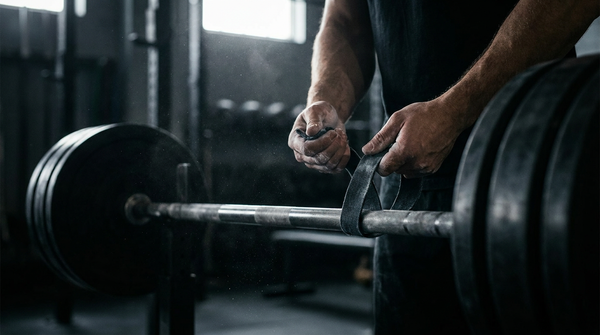
This is the standard wrap method for loop-style straps like the Battle Straps:
Step 1. Slide your wrist through the loop. The tail of the strap should come out from the bottom of your wrist, on the palm side.
Step 2. Position your hand over the bar. The tail hangs below your hand toward the bar.
Step 3. Push the tail under the bar, toward you, then wrap it back up and over the bar. You're wrapping the bar, not your wrist again.
Step 4. Continue wrapping the tail around the bar one full turn (or until the excess is used up). The strap should be snug against the bar, not loose.
Step 5. Close your hand around the bar and the strap together. The strap tightens as you pull down on the bar. The heavier the weight, the more secure it gets.
That's the whole setup. Once you've done it 10 times, it takes less than 10 seconds per hand.
Common Mistakes When Using Straps for Deadlift
Wrapping Too Loose
If the strap has slack when you grip the bar, it can slip during the pull. Wind it tight enough that there's no play between the strap and the bar before you begin the lift.
Wrapping Too Tight on the Wrist
The loop should be snug on your wrist but not cutting off circulation. If your hand goes numb before you finish your warmup sets, loosen it. Secure means firm contact, not tourniquet pressure.
Using the Wrong Part of the Bar
Position your strap wrap on the knurled section of the bar, inside the smooth collar section. The knurling helps grip the strap. Smooth bar sections let it slide.
Not Adjusting Strap Position Hand to Hand
Your dominant and non-dominant hands may feel different under load. Pay attention to which strap feels less secure and spend an extra half-wrap on that side if needed.
When to Use Straps in Deadlift Training
Use straps strategically, not automatically. Here's a practical framework:
Heavy sets at 85%+ of 1RM: Use straps. Your neural drive needs to be fully directed at executing the lift, not white-knuckling the bar.
High-volume sets (5+ reps per set): Use straps. Grip fatigue compounds quickly across sets. Straps let you maintain bar speed and pulling power through the set.
Singles, doubles, and triples at moderate intensity: Consider doing these without straps sometimes. If your goal includes building grip strength, do your lighter sets bare-handed.
Rack pulls and Romanian deadlifts: Use straps. These are accessory movements for loading the target muscles. Grip strength is not the limiting factor you're trying to train here.
Competition lifts (powerlifting): Straps are not allowed in most federations for the competition lift. Practice the lift without straps in your competition prep cycle. Use straps for accessory work.
Straps vs Mixed Grip for Deadlift
Mixed grip (one hand over, one hand under) is a common alternative to straps. It works. But it creates an asymmetrical load on your body that, over time, can contribute to imbalances and shoulder issues on the supinated (underhand) arm.
Straps let you pull double overhand throughout your session without grip failure. That's a more balanced position and a cleaner pull for high-volume training. Use mixed grip for competition or when you don't have straps. Use straps when you do.
Straps and Grip Strength: The Real Relationship
The concern most people have: will straps make my grip weaker?
If you only ever deadlift with straps and never train grip directly, yes, you're missing grip stimulus. But the solution isn't to avoid straps on your heavy sets. The solution is to also include direct grip work.
Dead hangs from a pull-up bar, farmer carries, barbell holds, and open-hand plate pinches are all effective for building grip strength. Add them to your sessions. Keep using straps on heavy deadlifts. Both things are true.
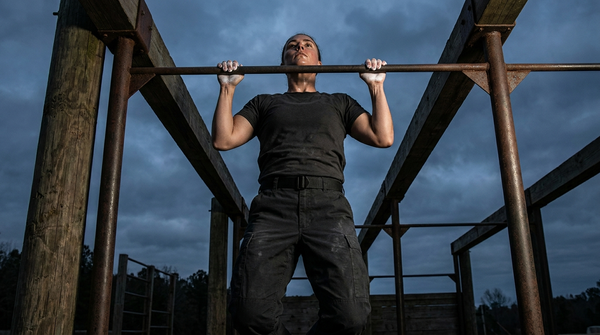
If you're also doing pull-ups, the grip and hanging demand from those sessions already addresses this. Most well-rounded athletes who train pull-ups, rows, and carry movements have strong grips whether or not they use straps on their deadlifts.
Choosing the Right Lifting Straps for Deadlift
Not all straps are the same. Things to look for:
- Padding: A padded wrist section prevents the strap from cutting into your wrist under heavy loads. This matters for longer sessions and high rep sets.
- Length: Enough tail to wrap the bar 1-2 times. Too short and you can't get a secure wrap. Too long and you're managing excess material.
- Material: Cotton and nylon both work. Nylon tends to be more durable. Avoid overly stiff or thin straps that dig in.
- Construction: Stitching quality matters. Cheap straps fail at the seam. The Battle Straps Weightlifting Straps are made with reinforced stitching and heavy neoprene padding at the wrist, built to hold up under consistent heavy use.
Put It to Work
Setup is half the game with lifting straps. Wrap them right, position them on the knurling, grip the bar and strap together, and pull. Once you've got the mechanics dialed in, straps stop being something you think about and start being just part of how you set up for heavy work.
If you're ready to stop fighting your grip on your deadlift days, the Battle Straps Weightlifting Straps are the tool. Made for the kind of training where you show up heavy and don't leave anything in the tank.