
Build a Stronger Core with Hanging Ab Straps

The best ab strap workout is built on four moves: hanging knee raises, oblique knee raises, straight-leg raises and toes-to-bar style raises, done for 3 to 4 sets of 6 to 15 slow reps, two to three times a week. Start with knee raises and move up one level only when you can hit the rep target with zero swing.
Below you get the full ab strap exercise library with coaching cues, a four-level progression with clear rules for when to move up, three ready-made routines and a 6-week plan. Wondering whether straps are worth it at all? Read do ab straps really work for the research.
What Are Ab Straps?
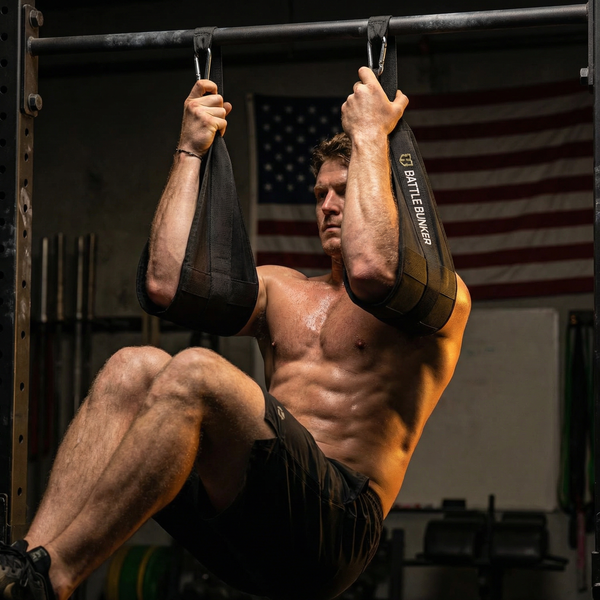
Ab straps (also called hanging ab straps or ab slings) are padded loops that hang from a pull up bar. You slide your arms in so the straps sit just above your elbows, and the straps hold your bodyweight while you raise your knees or legs. Your grip stops being the limit, so every set ends when your abs are done.

Battle Bunker Hanging Ab Straps are made from Cordura 1000D with reinforced stitching, 8-inch padded arm support and a fabric loop with carabiner closure. They are tested to support over 1,000 lbs and fit round bars from 1 to 2.5 inches in diameter, so they work on most pull up bars, racks and outdoor bars.

Core strength
Battle Bunker Hanging Ab Straps V2
Heavy-duty padding for knee raises, leg raises and windshield wipers without the straps digging into your arms. Carabiner closure, Cordura 1000D, tested to over 1,000 lbs.
Shop Ab Straps: $59.99Quick Setup Before You Train
Clip each strap around the bar and close the carabiner, space them about shoulder width, slide your arms in to just above the elbow, pull your shoulders down away from your ears and brace before the first rep. For bar choice, strap position and troubleshooting, see how to set up ab straps on a pull up bar.
The Ab Strap Exercise Library
1) Hanging Knee Raise (Beginner)
From a still hang, pull your knees up toward your chest, pause one second at the top, then lower in two to three seconds. Think about curling your hips up at the top, not just lifting your thighs.
Sets and reps: 3 sets of 10 to 15. Main work: rectus abdominis, obliques and hip flexors.
2) Static Knee Hold (Beginner)
Raise your knees to hip height and hold. Keep your ribs down and breathe behind the brace.
Sets and reps: 3 holds of 15 to 30 seconds.
3) Oblique Knee Raise (Beginner to Intermediate)
Drive both knees up and toward one shoulder, lower under control, then switch sides. Keep your upper body quiet. Only your hips should rotate.
Sets and reps: 3 sets of 8 to 10 per side.
4) Alternating Single-Leg Raise (Intermediate)
Keep one knee bent and raise the other leg straight to hip height. Alternate. This is the bridge between knee raises and full straight-leg raises.
Sets and reps: 3 sets of 8 per side.
5) Slow Negative Leg Raise (Intermediate)
Tuck your knees up, extend your legs straight at the top, then lower your straight legs over four to five seconds. You get the hardest part of the straight-leg raise without having to lift it yet.
Sets and reps: 3 sets of 6 to 8.
6) Straight-Leg Raise (Intermediate to Advanced)
Legs straight, toes pointed, raise your legs to at least hip height and lower slowly. If your legs start swinging, shorten the range and slow down. Full form breakdown: how to do a hanging leg raise.
Sets and reps: 4 sets of 8 to 12.
7) Toes-to-Bar Style Raise (Advanced)
Raise straight legs past hip height and keep curling your hips until your feet travel up toward the bar. Lower with control and kill the swing at the bottom. Your hamstring flexibility will decide how high you get.
Sets and reps: 3 to 4 sets of 6 to 8.
8) Windshield Wipers (Advanced)
Raise your legs high, then sweep them side to side in a slow arc. Keep your torso as still as you can. Start with bent knees if straight legs pull you off line.
Sets and reps: 3 sets of 6 to 8 total reps.
9) L-Hold (Advanced)
Raise straight legs to hip height and hold them there.
Sets and reps: 3 holds of 10 to 30 seconds.
How-to: strict oblique raises with ab straps, rotation without swing.
The Ab Strap Progression Ladder
Most people jump to straight-leg raises too early, swing through every rep and stall. Use these rules instead:
- Level 1: Knee raises and knee holds. Move up when you can do 3 sets of 15 strict knee raises with a one-second pause at the top and no swing.
- Level 2: Oblique knee raises and single-leg raises. Move up when you can do 3 sets of 10 oblique raises per side and 3 sets of 8 single-leg raises per side.
- Level 3: Slow negatives and straight-leg raises. Move up when you can do 4 sets of 12 straight-leg raises to hip height with a slow lowering phase.
- Level 4: Toes-to-bar style raises, windshield wipers and L-holds. Keep progressing with more reps, slower tempo, longer holds or light ankle weights.
Stuck between levels? Keep the easier move as your main work and add one set of the harder move at the start of the session when you are fresh.
Three Ab Strap Workouts
Beginner Ab Strap Workout (about 10 minutes)
- Hanging knee raise: 3 x 10 to 12
- Static knee hold: 3 x 15 to 20 seconds
- Oblique knee raise: 2 x 6 per side
Rest 60 seconds between sets.
Intermediate Ab Strap Workout (about 15 minutes)
- Hanging knee raise: 3 x 15
- Oblique knee raise: 3 x 8 per side
- Slow negative leg raise: 3 x 6
- Alternating single-leg raise: 2 x 8 per side
Rest 60 to 90 seconds between sets.
Advanced Ab Strap Workout (about 20 minutes)
- Straight-leg raise: 4 x 10 to 12
- Toes-to-bar style raise: 3 x 6 to 8
- Windshield wipers: 3 x 6 to 8 total
- L-hold: 3 x 15 to 30 seconds
Rest 90 seconds between sets. Every rep strict, no kipping.
Follow-along: 7-minute ab strap session. Good as a finisher.
A 6-Week Ab Strap Plan
Train hanging core work two or three times a week with at least one day between sessions. Log your reps every time.
- Weeks 1 to 2: Beginner workout. Add one rep per set each session until you hit 15 knee raises per set.
- Weeks 3 to 4: Intermediate workout. Slow every lowering phase to three seconds. Try one set of straight-leg raises at the end of each session.
- Weeks 5 to 6: Swap knee raises for straight-leg raises if you passed the Level 2 test. Otherwise repeat the intermediate workout with more reps.
After six weeks, retest your best set of strict knee raises or leg raises. That number is your scoreboard.
Where Ab Strap Work Fits in Your Week
Put it at the end of a lifting session or run it as a short standalone session on an off day. If you already train pull ups, superset them with hanging raises on the same bar. Our pull up bar ab straps guide has a pull up plus leg raise superset you can drop straight into your program.
Common Ab Strap Workout Mistakes
- Swinging or kipping: Momentum does the work your abs should be doing. Pause at the bottom of every rep.
- Shrugging: Shoulders up by your ears strains your neck and traps. Pull them down before you start.
- Stopping at the thighs: Lifting your knees to hip height without curling your pelvis up leaves ab work on the table.
- Dropping the legs: A fast lowering phase cuts the hardest half of the rep. Take two to four seconds down.
- Holding your breath: Exhale as you lift, inhale as you lower.
- Doing knee raises forever: Follow the ladder. Progress when you pass the test.
- Training to failure every day: Your abs recover like any other muscle. Two or three hard sessions a week is enough.
Final Thoughts
A good ab strap workout is simple: a few hanging moves, strict reps, slow negatives and a clear rule for when to progress. Grab a set of hanging ab straps, start at Level 1 and log every session.
Frequently Asked Questions
What is the best ab strap exercise?
Start with the hanging knee raise. In a 2006 EMG study in Physical Therapy, the hanging knee-up with straps was one of the top exercises tested for rectus abdominis and oblique activity. Progress to straight-leg and toes-to-bar style raises as you get stronger.
How many sets and reps should I do with ab straps?
Most lifters do well with 3 to 4 sets of 6 to 15 controlled reps per exercise. Beginners stay toward 10 to 15 knee raises, and advanced lifters use 6 to 12 reps of harder straight-leg variations.
How often should I do an ab strap workout?
Two to three times per week, with at least one rest day between hard sessions. That gives your abs time to recover so you can add reps each week.
Can beginners use ab straps?
Yes. Ab straps make hanging core work easier to learn because you do not need a strong grip. Start with knee raises and static knee holds, then follow the progression ladder.
How do I make ab strap exercises harder?
Move to a harder variation, slow the lowering phase to three to five seconds, add a pause at the top, hold an L-hold longer or add light ankle weights once your form is solid.