Best Resistance Bands for Pull-Up Training: A Practical Gear Guide

Pull-ups are a foundational exercise for building upper body strength, improving grip, and developing overall athleticism. Yet many athletes struggle with this movement due to insufficient pulling strength or technique gaps. Resistance bands are one of the most practical tools to close that gap: they provide scalable assistance, train the correct movement pattern, and let you build strength progressively. In this guide, we'll cover the best resistance bands for pull-up training, how to use them effectively, and what else to add to your training to get to unassisted reps.
Why Use Resistance Bands for Pull-Up Training?
Resistance bands have become a staple in hybrid training and military-style fitness routines. Here's why they're a smart choice for anyone serious about pull-ups:
- Assistance for Beginners: Bands reduce the amount of bodyweight you need to lift, helping beginners complete pull-ups while building foundational strength.
- Progressive Overload: Bands come in different tension levels. As you get stronger, move to a lighter band. The progression is built in.
- Better Form and Control: Bands provide consistent assistance through the movement, which helps maintain proper technique instead of muscling through with momentum.
- Versatility: Beyond pull-ups, resistance bands are useful for warm-ups, mobility drills, and accessory exercises. One set of bands does a lot of work.
- Portability: Lightweight and compact. Toss them in a bag and train anywhere.
Key Features to Look for in Resistance Bands for Pull-Up Training
Not all resistance bands are built the same. Here's what matters when you're buying for pull-up training:
- Resistance Levels: You need a range. Beginners will need heavy assistance bands. Advanced athletes might only need a light band for fine-tuning or deload weeks. Color-coded sets make it easy to track where you are.
- Material Quality: Durable natural latex resists snapping and holds elasticity over hundreds of uses. Cheap synthetic bands lose tension quickly and can snap unexpectedly, which is a real safety issue when you're hanging from a bar.
- Length and Width: Longer bands give more versatility. Wider bands distribute tension more evenly and tend to feel more comfortable under knees or feet.
- Loop Design: Simple closed-loop bands are ideal for pull-up assist. They loop around the bar cleanly and don't need anchors or handles.
Battle Bunker Resistance Bands for Pull-Up Training
Battle Bunker's 3-Pack Battle Bands are built for exactly this type of training. Here's what sets them apart:
- Material: 100% natural latex for maximum durability and consistent elasticity
- Resistance Levels: Available in multiple tensions from light to heavy, covering every stage of pull-up development
- Length: 41 inches, sized to loop cleanly over pull-up bars and accommodate varied body sizes
- Design: Non-slip texture prevents band movement during sets
The 3-pack format is deliberate. You'll start with the heaviest band, work down to medium as strength improves, and use the light band toward the end of your progression before going unassisted. Having all three on hand means you don't need to order again mid-program.
How to Use Resistance Bands for Pull-Up Training
Step 1: Choose the Right Band
Pick a band that lets you complete 6-10 reps with solid form, but where the last 2-3 reps are genuinely hard. If you can hit 10 reps easily, drop to the next band down. If you can't complete a single rep, go heavier.
Step 2: Set Up the Band
- Loop the band over the pull-up bar and pull one end through the other (lark's head knot).
- Make sure it's seated securely and won't shift when you load it.
- Step or knee into the bottom loop. Knees inside the band is the most stable position for beginners.
Step 3: Nail the Technique
- Before you pull, retract your shoulder blades. Pull them down and back. This is the most commonly skipped step and the one that protects your shoulders.
- Drive your elbows down and back, pulling your chest toward the bar.
- Control the descent. Don't drop. Lower yourself over 2-3 seconds on every rep.
Step 4: Progress Off the Bands
Track your reps weekly. When a band stops challenging you, drop down. When you can do 5+ clean reps with the lightest band, start mixing in unassisted attempts. One or two unassisted reps at the start of a set, then band for the rest, is a legitimate transition strategy.
Supporting Your Pull-Up Training with Other Gear
Bands are the main tool, but a couple of accessories extend your training capacity:
- Wrist Wraps: Reduce wrist fatigue during high-volume pull-up sets and provide joint support on weighted variations.
- Lifting Straps: Take grip out of the equation during heavy sets so your back and arms set the limit, not your hands.
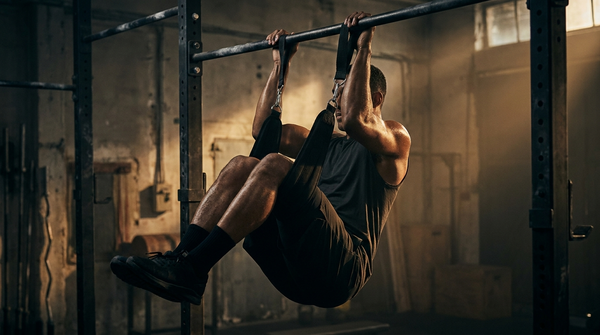
- Ab Straps: Pair pull-up work with hanging core exercises in the same session. Ab straps let you hit leg raises without grip fatigue cutting the set short.
Combining resistance bands with these accessories gives you a complete upper body training setup without needing a full gym.
Additional Tips to Improve Your Pull-Ups Faster
- Negative Pull-Ups: Jump to the top position and lower yourself as slowly as possible. This builds eccentric strength even before you can pull up at all.
- Isometric Holds: Hold at the midpoint or top position for 10-20 seconds to increase time under tension.
- Grip Variations: Train wide grip, neutral grip, and chin-up positions to develop balanced upper body pulling strength.
- Frequency: 2-3 times per week is the sweet spot. More than that doesn't accelerate progress for most people due to recovery demands.
- Accessory Work: Rows, lat pulldowns, and face pulls build the same muscle groups and carry over directly to pull-up strength.
Final Thoughts: Get to Unassisted Reps with the Right Tools
Pull-ups are a reliable test of upper body strength and control. Using the best resistance bands for pull-up training is not a shortcut. It's a structured, proven method for building the real strength needed for unassisted reps. Battle Bunker's resistance bands are built for athletes who train seriously and want gear that holds up to consistent use.
Whether you're starting from zero or refining your pull-up technique for a military fitness test or competition, a good set of bands combined with deliberate programming will get you there. Add wrist wraps and lifting straps when volume goes up and grip becomes the limiting factor.
Ready to build serious pull-up strength? Grab the Battle Bunker 3-Pack Battle Bands and get to work.