
Military Press: Proper Form, Muscles Worked, and How to Get Stronger Overhead

The military press is the no-excuses version of the overhead press. Feet close together, no lean, no leg drive, just you pressing a barbell from your shoulders to lockout. It earned its name from old physical training manuals where soldiers were tested on a strict press at attention, and it remains one of the best measures of raw upper-body strength you can train.
Military Press vs Overhead Press vs Push Press
The terms get mixed up constantly, so here is the clean breakdown. The overhead press is the umbrella term for pressing a load from shoulders to overhead while standing, usually with feet around shoulder width. The military press is the strictest variation, performed with heels close together and zero help from the legs or back. The push press adds a deliberate dip and drive from the knees so you can handle 10 to 30 percent more weight. All three belong in a program, but they are not interchangeable, and your numbers on each will differ.
Muscles Worked
The prime movers are the anterior and lateral deltoids and the triceps, with the upper chest assisting off the shoulders. What most people underestimate is everything below the bar. Your traps and serratus rotate the shoulder blades, and your core, glutes, and even quads have to lock your body into a rigid column so force goes into the bar instead of leaking into a wobbly torso. A heavy strict press is as much a full-body brace as it is a shoulder exercise, which is exactly why it transfers to carrying, pushing, and lifting under load in the real world.
How to Military Press with Proper Form
Set your base
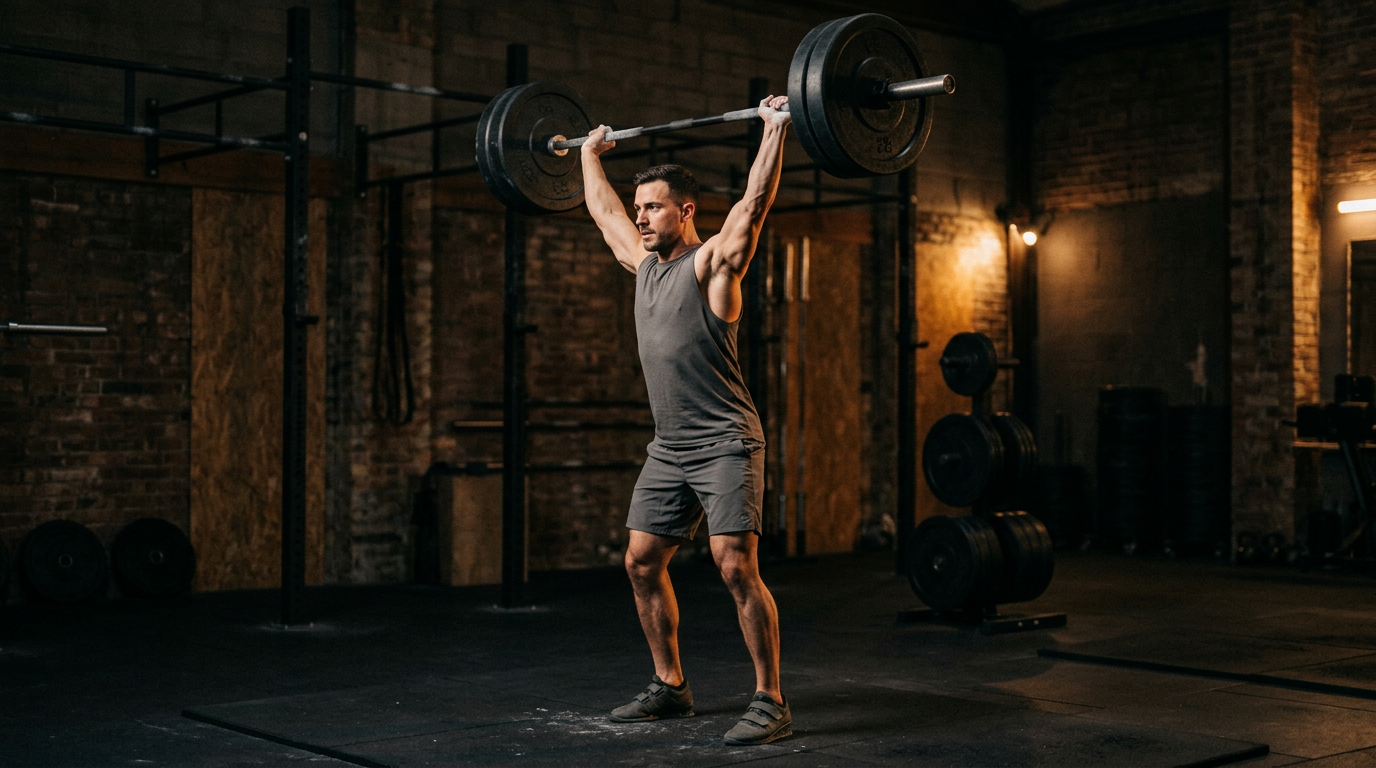
Take the bar from a rack at collarbone height. Grip just outside shoulder width, elbows slightly in front of the bar, forearms vertical. Bring your heels close together, squeeze your glutes, and brace your trunk hard.
Press and lock out
Pull your chin back, press the bar in a straight line past your face, and push your head through once the bar clears your forehead. Finish with the bar stacked over your shoulders, hips, and mid-foot, elbows fully locked. Shrug up slightly at the top so your shoulder blades support the load.
Lower under control
Bring the bar back down to your collarbones along the same path. Reset your brace before every rep. If your lower back arches or your knees bend, the weight is too heavy for a strict press that day.
How Much Should You Be Able to Press?
Strict pressing strength builds slowly, and that is normal. A common long-term benchmark for a strong strict press is around three quarters of bodyweight for men and around half of bodyweight for women, with a full bodyweight press being an elite goal that takes years. Do not chase someone else's number. Add small amounts of weight consistently, and track your progress the same way you would track a run time.
Programming: How to Build a Bigger Press
Press twice a week. One heavy day of 5 sets of 3 to 5 strict reps, and one volume day of 3 to 4 sets of 6 to 10 with lighter weight or dumbbells. Because the press uses small muscle groups relative to a squat or deadlift, it responds well to frequency and hates big weight jumps, so use the smallest plates in the gym. When you stall, switch four weeks to push presses and seated dumbbell presses, then come back to the strict bar press and you will usually blow past the old number.
Strong presses also need strong wrists, and a stacked, neutral wrist position is worth free pounds. If your wrists fold backward under the bar, our guide on how to use wrist wraps shows how to set the right tension for pressing. A rigid midsection matters just as much, and for heavy overhead work many lifters brace better with a belt, which we cover in our guide to choosing the right lifting belt.

Why Overhead Strength Matters for Tactical Athletes
Military and first-responder work is full of pressing: loading gear overhead, pushing off the ground in kit, controlling a litter, boosting a teammate over a wall. While no current service PT test scores a barbell press directly, the pushup events on every branch test draw on the same shoulders and triceps, and a stronger strict press makes high-rep pushups feel lighter. If you are prepping for a test, benchmark yourself with the free military PT calculators and let your overhead work feed those scores.
FAQ
Is the military press the same as the overhead press?
Almost. Both press a bar from shoulders to lockout while standing. The military press is the strict version with heels close together and no leg drive, while overhead press is the broader term that allows a shoulder-width stance.
Is the military press bad for your shoulders?
For healthy shoulders with sensible loading, it is one of the best builders of shoulder strength and stability. Problems usually come from pressing through pain, arching the lower back, or adding weight faster than technique allows. If you lack the mobility to lock out overhead without arching, work on lats, triceps, and upper-back mobility first.
Why is my military press so weak?
Because it is the most honest lift in the gym. There is no stretch reflex, no leg drive, and small prime movers. Slow progress is normal, so measure gains monthly, not weekly.
Should I press seated or standing?
Standing builds more total-body strength because your trunk has to stabilize the load. Seated presses are a useful accessory for adding pressing volume with less fatigue.
How heavy should wrist wraps users go before wearing them?
Save wraps for your heavier work sets, roughly the top 20 to 30 percent of your loading. Warmups and light sets are where your wrists build their own strength.