
Trap Bar Deadlift: Form, Benefits, and How to Program It

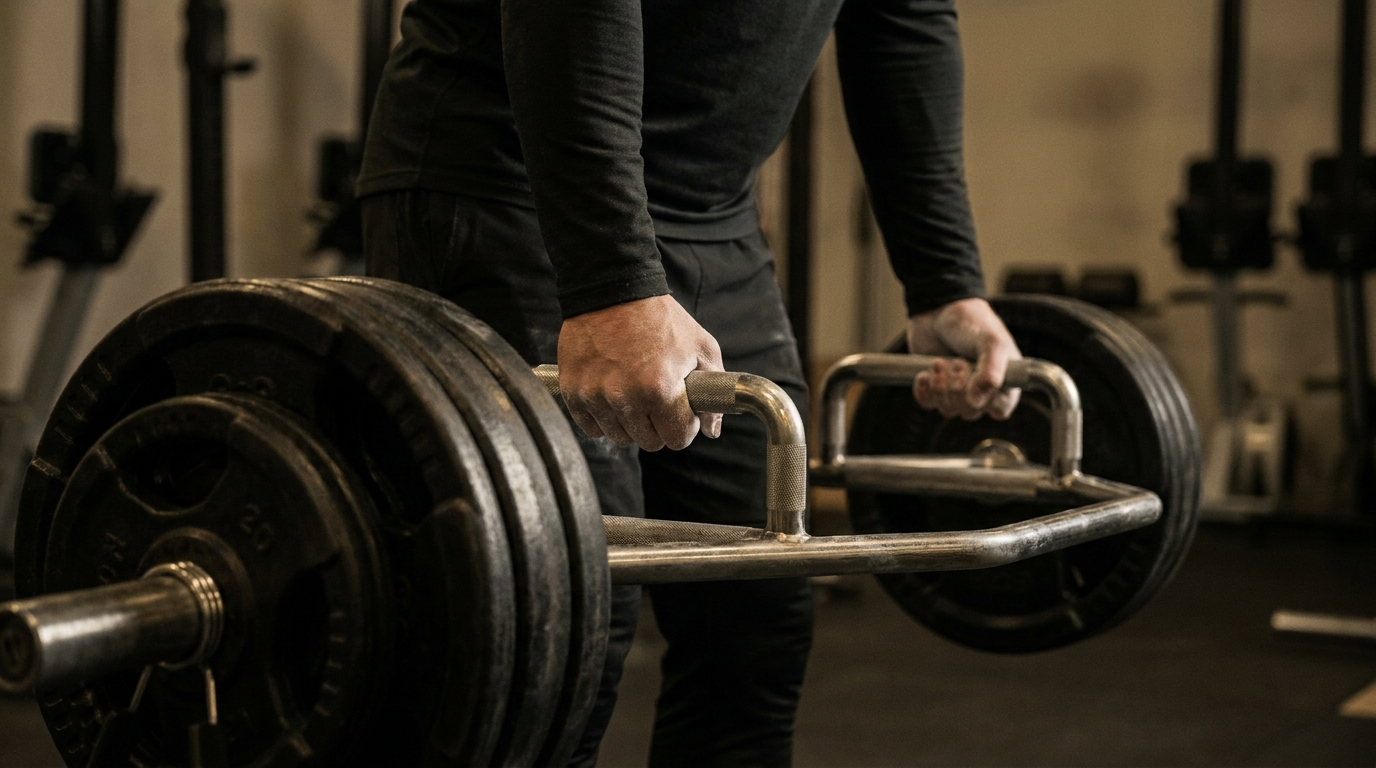
The trap bar deadlift, also called the hex bar deadlift, is the most useful pull most lifters are not doing. You stand inside a hexagonal frame, grip neutral handles at your sides, and drive the floor away. The load sits closer to your center of mass than it does with a barbell, which means more weight moved, less shear on the spine, and a movement that carries over directly to sport, work, and military fitness tests.
What the Trap Bar Deadlift Works
This is a total-body pull. The prime movers are the glutes, hamstrings, and quads, with the quads doing more work than they do in a conventional deadlift because your hips start slightly lower and your torso stays more upright. Your spinal erectors, lats, and core brace the load, and your traps and grip fight to hold on for every second of the set. If you only have time for one heavy lower-body lift in a training week, this is a strong pick.
How to Do It: Step by Step
Set up
Step inside the bar and place your feet hip to shoulder width apart, centered between the handles. Hinge your hips back, bend your knees, and take the handles in the middle of the grips. Pull your shoulders down, brace your trunk like you are about to take a punch, and flatten your back.
The pull
Push the floor away through your whole foot and stand up in one piece. Hips and shoulders rise together. Lock out tall with glutes squeezed, then push your hips back and lower the bar under control. Every rep starts from a dead stop, not a bounce.
Common mistakes
The three most common errors are letting the hips shoot up first so the lift turns into a stiff-leg pull, drifting forward onto the toes, and rushing the descent. Fix them by slowing down, filming a set from the side, and treating the eccentric as part of the rep.
Trap Bar vs Barbell Deadlift
Neither is better for everyone, but they solve different problems. The barbell deadlift demands more from the posterior chain and rewards technical skill. The trap bar version lets most athletes handle 5 to 10 percent more load with a more upright torso, which lowers stress on the lumbar spine and makes it easier to learn. For hybrid athletes and anyone training for a fitness test, the trap bar wins on risk-to-reward. For competitive powerlifters, the straight bar stays in the plan because that is what is tested on the platform.
Why It Matters for the Army Fitness Test
The first event of the Army Fitness Test is the 3-repetition maximum deadlift, performed on a 60 pound hex bar. A 340 pound pull earns the top score for men in the 17 to 21 age bracket, and every soldier needs to clear their minimum to pass. Belts are not authorized on the test, so build your brace without one. If you are prepping for the AFT, train the exact implement you will be tested on, then check your projected score with the free Army AFT calculator. For a deeper look at the event itself, read our guide on how to hit 340 pounds on the test deadlift and the full breakdown of the Army AFT standards.
How to Program the Trap Bar Deadlift
For strength, pull heavy once a week: 4 to 5 sets of 3 to 5 reps at a weight that leaves one or two reps in the tank, adding a little load every week or two. For work capacity, use moderate weight for 3 sets of 8 to 10, or put light trap bar pulls inside a circuit. Test-prep athletes should work up to heavy triples, since the AFT scores a 3-rep max. Jumps with a light trap bar also build the explosive hip power that shows up in sprints and carries.
As sets get heavy, grip usually gives out before the legs do. Train your grip hard with dedicated work like the exercises in our grip strength training guide, and use straps on your highest-volume back-off sets so your posterior chain still gets the stimulus. Our guide to when to use lifting straps covers exactly where they belong in a deadlift program.

A Simple 4-Week Trap Bar Block
Week 1: 4 sets of 5 at a comfortable but challenging weight. Week 2: 5 sets of 4, slightly heavier. Week 3: 5 sets of 3, heavier again. Week 4: work up to a strong 3-rep top set, then drop 20 percent for 2 back-off sets of 5. Pair each session with a hinge accessory such as Romanian deadlifts, a loaded carry, and a core exercise, and you have a lower-body day that covers strength, grip, and conditioning in under an hour.
FAQ
Is the trap bar deadlift easier than a barbell deadlift?
It is easier to learn and easier on the lower back, but it is not easier as an effort. Most lifters can actually pull more weight on a trap bar, so the training stimulus stays high while the technical barrier drops.
How much more can you lift on a trap bar?
Most athletes pull roughly 5 to 10 percent more on a trap bar than on a straight bar, mainly because the load is centered with your body and the torso stays more upright.
Does the trap bar deadlift build the same muscles?
It hits the same chain of glutes, hamstrings, and back, with a bigger contribution from the quads. Think of it as sitting between a conventional deadlift and a squat.
What weight hex bar does the Army use for the AFT?
The test uses a 60 pound hex bar loaded with plates, and you pull a 3-repetition maximum. Scoring scales by age and sex, so run your numbers through the free Army AFT calculator to see where you stand.
Should beginners start with the trap bar?
Yes. The neutral grip and centered load make it one of the safest ways to learn to hinge and pull heavy. Start light, own the technique, and add weight gradually.