
Sled Training: Push, Drag, and Pull Workouts That Build a Bigger Engine

The weight sled is the rare tool that builds strength and conditioning in the same session while leaving almost no soreness behind. There is no eccentric phase, so your legs are not wrecked the next day, and the intensity scales from easy aerobic work to all-out sprints just by changing the load. That is why sleds show up everywhere from football fields to Hyrox courses to the Army combat fitness test.
Why Sled Training Works
Every push or drag is pure concentric work. Your muscles produce force, the sled moves, and there is no lowering phase to create the muscle damage that leaves you limping after heavy squats. That means you can train sled work hard and often, even alongside a full lifting and running schedule. It builds leg drive, hip extension, calf and foot strength, trunk stiffness, and the kind of grinding work capacity that carries over to rucking, hills, and every fitness test with a sprint or a carry in it.
The Big Three Sled Movements
Sled push
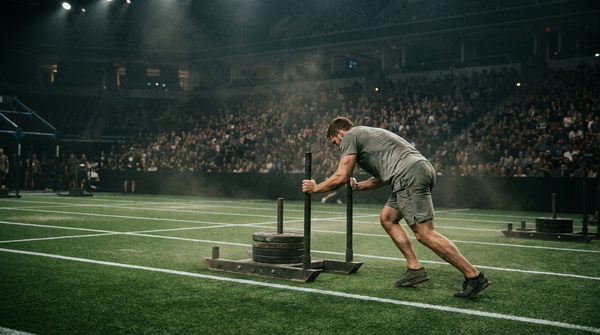
Hands on the poles, arms locked or bent and rigid, flat back, and a forward lean of roughly 45 degrees. Drive with full-foot contact and take deliberate steps. Heavy pushes build raw leg strength. Lighter, faster pushes train acceleration.
Sled drag
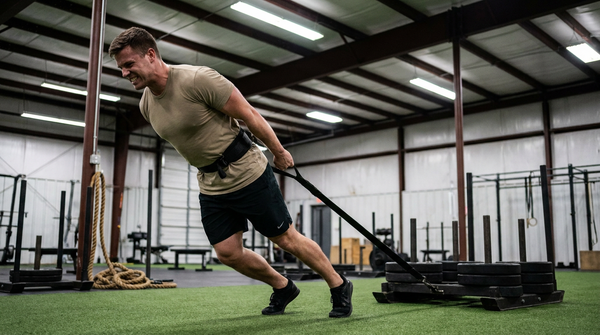
Face away from the sled with a harness or rope over your shoulders and march forward, or face the sled and walk backward. The backward drag is one of the best knee-friendly quad builders in existence and a favorite rehab tool for cranky knees.
Sled pull
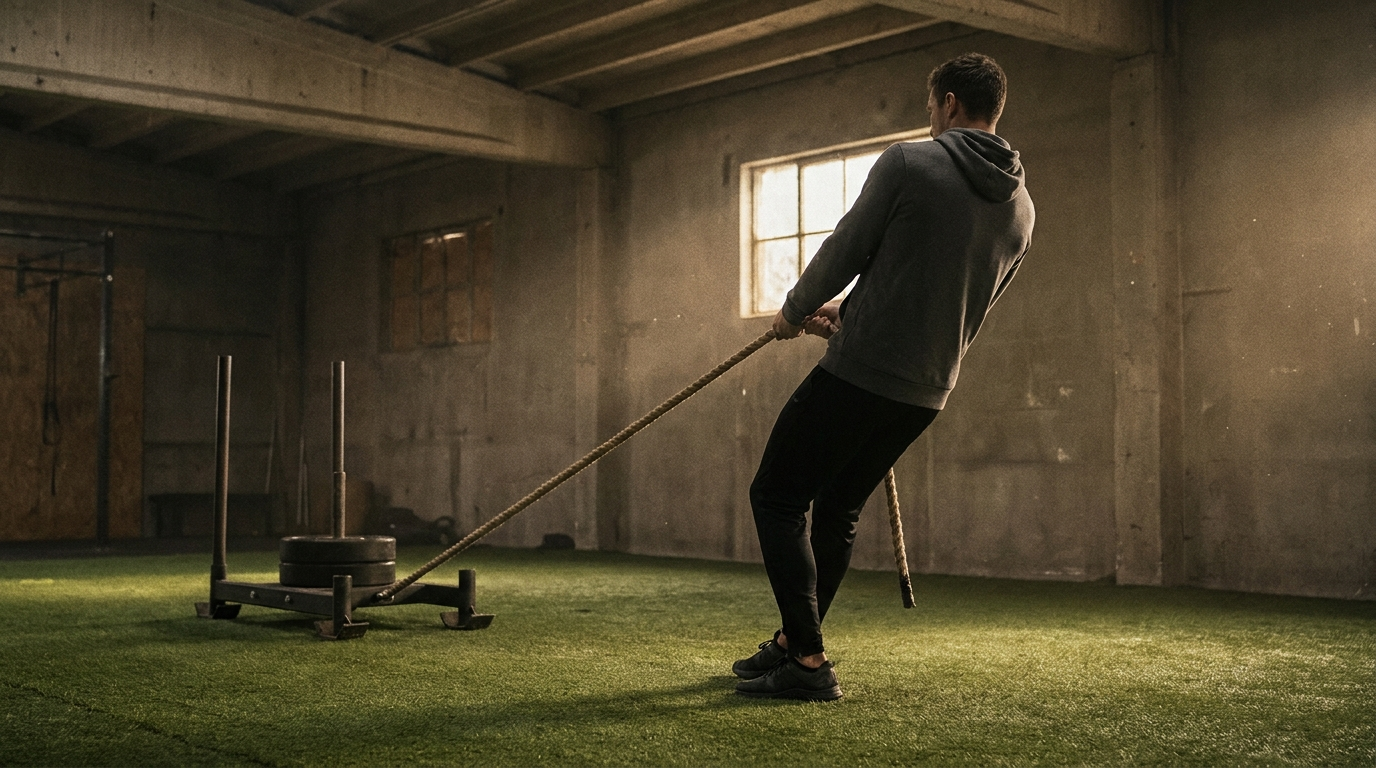
Face the sled, sit your hips back, and pull it to you hand over hand with a rope. This one loads your grip, arms, back, and hips, and it doubles as direct prep for the rope and drag portions of obstacle events.
How Much Weight Should You Load?
Let speed and purpose decide. For acceleration and speed work, keep loads light enough that your sprint mechanics stay clean. For strength, load the sled heavy enough that you move at a slow, grinding march but never stall completely. For conditioning, pick a moderate load you can move for repeated 20 to 40 second efforts with short rest. Surfaces change everything, since turf, rubber, and concrete all drag differently, so ignore the number on the plates and pay attention to how the sled moves.
Three Sled Workouts That Deliver
First, the strength builder: 8 rounds of a 20 yard heavy push, resting 90 seconds between efforts. Second, the engine builder: 10 rounds of a 30 second moderate push or drag with 30 seconds of rest, which lands like hill sprints without the pounding. Third, the leg finisher: superset a 40 yard backward drag with a 40 yard forward march drag for 5 rounds and walk away without the soreness a squat finisher would cost you. If you are building toward a race, our Hyrox training plan for beginners shows where sled work slots into a full week.
Sled Work and the Military Fitness Connection
The Army's fitness test includes a sprint, drag, and carry event where soldiers drag a 90 pound sled backward for 50 meters as part of a 250 meter shuttle. If that event is in your future, backward drags belong in your training now. Read our sprint drag carry pacing and technique guide for event-specific strategy, then project your score with the free Army AFT calculator.
No Sled? Use a Sandbag
Most garage gyms and even many commercial gyms have no sled and no turf. A heavy sandbag covers most of the same ground. Drag it across grass or concrete with a strap for the same grinding hip and leg drive, carry it for loaded conditioning, and shoulder it for full-body power. The pattern is nearly identical to sled work, and our full-body sandbag training plan builds an entire program around it.

How to Add Sled Work to Your Week
Two sessions per week is plenty for most athletes. Put heavy sled strength work after your lower-body lifting day, and use lighter conditioning pushes or drags on a separate day as a hard cardio session. Because recovery cost is low, a third short session of easy drags can even serve as active recovery. Start conservative for two weeks, since the lack of soreness makes it tempting to overdo volume before your feet, calves, and hips have adapted to the new stimulus.
FAQ
What muscles does the sled push work?
Quads, glutes, hamstrings, and calves drive the sled, while your core, chest, shoulders, and arms hold your body rigid against the poles. Backward drags shift nearly all the work to the quads.
Is sled training good for fat loss?
It is an excellent conditioning tool. Repeated pushes and drags burn a lot of energy and preserve muscle, and because they cause little soreness you can do them more often than most hard cardio.
How heavy should a sled push be?
Heavy enough to slow you to a march for strength work, light enough to sprint cleanly for speed work, and somewhere in between for conditioning. The surface changes the effective load, so judge by movement speed rather than plate math.
Can I do sled workouts every day?
Light drags can be done frequently, but hard pushes are still stressful to your legs and nervous system. Two to three quality sessions per week beats daily grinding.
What can I use instead of a sled?
A heavy sandbag dragged across grass or floor is the closest substitute, followed by hill sprints and loaded carries. A tire on a rope also works if you have the space.