
What Is Rucking? Benefits, How Much Weight, Pace and How to Start

Rucking is walking with weight on your back. That is the whole idea. Soldiers have done it forever because it is how they move gear, and it has become one of the most popular ways to train because almost anyone can do it, it builds real endurance, and it burns far more energy than a normal walk. This guide covers what rucking is, what it does for you, how much weight to carry, how fast to go, the gear you need, and a simple plan to start.
Already training for a military standard? Our ruck march guide covers the Army's 12-mile, 35-pound, 3-hour benchmark in detail.
What is rucking?
Rucking means carrying a loaded backpack, called a ruck or rucksack, and walking with purpose. It is not hiking with a day pack and it is not running. The weight is the training stimulus, and the pace is a fast walk you can hold for a long time.
The name comes from the military. The Army calls it a foot march, and its doctrine, ATP 3-21.18 Foot Marches, covers pace, load, packing and foot care. Outside the military, rucking took off as a fitness habit because it sits in a useful middle ground: harder than walking, easier on the joints than running, and doable on any sidewalk, trail or track.
What rucking does for your fitness
- Endurance. Rucking is mainly an endurance workout. It builds the muscular endurance of your legs, hips and trunk and keeps your heart rate up for long stretches.
- Calories. Carrying weight raises the energy cost of every step. Army doctrine estimates a 180-pound soldier carrying 35 pounds at a 15-minute mile burns about 2,040 calories over 12 miles, roughly 680 an hour. Run your own numbers in our ruck pace and calorie calculator.
- Load tolerance. Your feet, ankles, hips and back get used to carrying weight. That is exactly what selection courses, fire academies and long field days ask for.
- Lower impact than running. You never leave the ground, so each step is gentler than a running stride. Heavy loads are a different story, which is why you build up slowly.
Rucking is not a replacement for strength training. A 2012 systematic review found that load-carriage performance improves most when progressive loaded marches are combined with aerobic and resistance training (Knapik and colleagues, 2012). Ruck once or twice a week, and keep lifting and running.
How much weight should you ruck with?
Start light. For fitness, begin around 10 percent of your bodyweight, or 20 pounds or less, and add weight only after the distance feels easy. Army doctrine says training loads should start light and distances short, then build.
| Your bodyweight | Starting load (about 10 percent) | A common next step |
|---|---|---|
| 125 lb | About 12 lb | 20 lb |
| 150 lb | About 15 lb | 20 to 25 lb |
| 175 lb | About 18 lb | 25 to 30 lb |
| 200 lb | About 20 lb | 30 to 35 lb |
For context, military loads are much heavier. Army doctrine says a soldier's fighting load should ideally be about 30 percent of bodyweight, and approach march loads should not exceed 100 pounds. Those are working loads for trained soldiers, not starting points. Heavy loads carry real injury risk: in one Army study, 24 percent of soldiers were injured on a single 20-kilometer march carrying about 100 pounds (Knapik and colleagues, 1992).
How fast should you ruck?
A brisk walk. Army doctrine plans a foot march at about 3 miles per hour, a 20-minute mile, and about 2.5 miles per hour overall once rest halts are included. Military badge standards are faster: 12 miles in 3 hours is a 15-minute mile, or 4 miles per hour. For your first rucks, aim for a pace where you could still hold a conversation, somewhere between a 15 and 20-minute mile. Our ruck pace calculator turns any distance and goal time into splits.
Rucking gear: what you actually need
- A pack that carries weight well. A sturdy backpack with padded shoulder straps works to start. A dedicated ruck with a sternum strap and hip belt is more comfortable as loads go up.
- Weight that does not move. Purpose-made ruck plates sit flat against your back. Sandbags or water jugs work too. Keep the weight high and close to your body: Army doctrine says packing heavier items higher and closer lowers the energy cost of carrying them.
- Shoes and socks. Trail shoes or broken-in boots. Army doctrine says foot blisters and abrasions are the most common load-related injury and that acrylic socks reduce the number and size of blisters. Avoid cotton.
- Water. Bring it on anything over 45 minutes. Water you carry adds to the load, so count it.
- Visibility. A light or reflective band if you ruck early or late near roads.
More detail on packs and packing is in our guide to how to do a ruck march.
Rucking with a weight vest
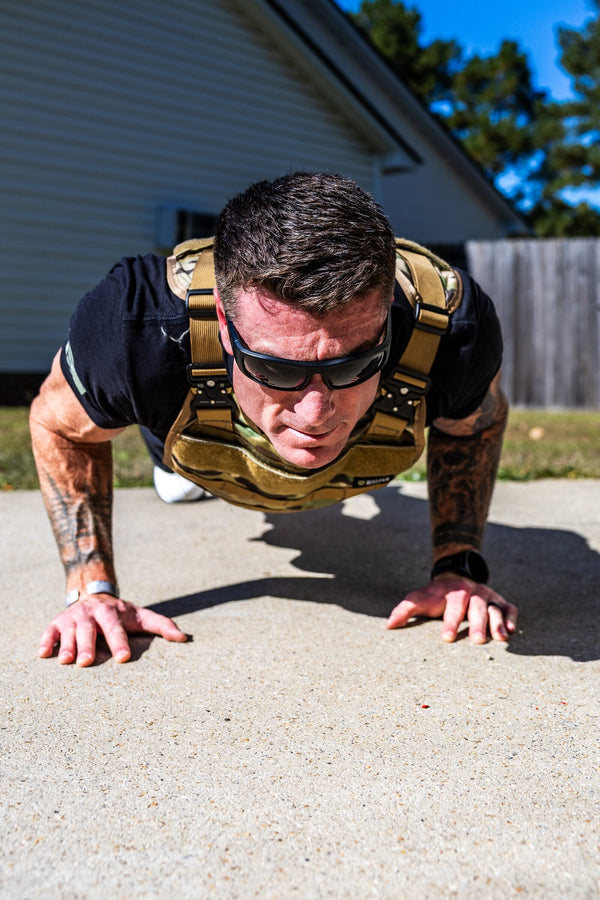
A weight vest is the other way to ruck. It spreads the load around your chest and back instead of hanging it off your shoulders, it stays put when you speed up, and it doubles as a tool for push-ups, pull-ups and lunges. A rucksack is better when you need to carry water and gear on long routes or practice for a military ruck. The 75th Ranger Regiment's prep guide says a weight vest works for loaded walking when you have no ruck. We break down the trade-offs in rucking vest vs rucksack.

The Hybrid Weight Vest MK2
Keeps the load high and tight to your body for rucks, then turns push-ups, pull-ups and lunges into strength work. Adjustable plates, from $199.99.
Shop the VestHow to start rucking: an 8-week plan
One or two rucks a week, alongside your normal running and strength work. Never raise the weight and the distance in the same week.
| Weeks | Distance | Load | Focus |
|---|---|---|---|
| 1 to 2 | 2 miles | About 10 percent of bodyweight | Pack fit, posture, foot care |
| 3 to 4 | 3 miles | Same | Add distance, not weight |
| 5 to 6 | 3 miles | Add 5 to 10 lb | Add weight, hold distance |
| 7 to 8 | 4 to 5 miles | Same | Hold a steady 15 to 18-minute mile |
Ready for a real target after that? Our free 12-mile ruck program builds you to the 3-hour military standard, and the RASP 12-mile ruck progression goes further.
Track your rucks
A simple log keeps you honest and shows when you are ready to add weight. After each ruck, write down the date, distance, load, total time, average pace, how hard it felt on a 1 to 10 scale, and any hot spots on your feet. When the same route at the same load feels like a 5 or 6 out of 10 two weeks in a row, it is time to add distance or weight.
Common rucking mistakes
- Too heavy, too soon. The most common way to get hurt. Add distance first, weight second.
- Weight sitting low. A plate dropped in the bottom of a pack pulls you backward. Keep it high and close.
- Running with a ruck. A fast walk or ruck shuffle is the goal. Running under load multiplies the stress on your joints.
- Ignoring hot spots. Stop and fix a hot spot at the first sign, not at the end.
- Leaning too far forward. Some lean is normal under load. Excessive lean strains your lower back, so keep your chest up.
Rucking FAQ
Is rucking better than walking?
For fitness, yes. The added load raises the energy cost and builds strength endurance that a normal walk does not. It is also harder on your feet and back, so build up gradually.
How often should I ruck?
Once or twice a week is plenty for most people, with running and strength work on other days. Military candidates building toward a 12-mile standard often ruck twice a week with one longer effort.
Is rucking good for weight loss?
It burns more calories than walking the same distance, and it is easy to do for an hour. As with any exercise, what you eat the rest of the day decides the result. Our calorie calculator sets a daily target.
Can I ruck every day?
Light, short rucks can be done often, but heavy or long rucks need recovery. Give your feet and back at least a day between hard efforts.
What is a good rucking pace?
Start at a 15 to 20-minute mile. The common military standard is a 15-minute mile, 12 miles in 3 hours with 35 pounds.
Sources: U.S. Army ATP 3-21.18, Foot Marches; Knapik and colleagues, Military Medicine (1992) on injuries during a 20-kilometer road march; Knapik and colleagues, Journal of Strength and Conditioning Research (2012) systematic review of load-carriage training. Battle Bunker is not affiliated with the Department of Defense.