
Sandbag Exercises: The Complete Guide to Building Strength With One Bag

A loaded barbell is predictable. A sandbag is not, and that is exactly why it works. The load shifts, the grip is awkward, and every rep forces your core and stabilizers to fight for position. That instability is what makes sandbag training transfer so well to sport, manual work, and military fitness tests, where nothing you lift comes with knurled handles.
This guide covers the sandbag exercises that earn their place, how to program them, and how to choose a bag. If you are specifically chasing loaded carries, our sandbag carry workout guide goes deeper on that single movement.
Why Train With a Sandbag?
Three reasons. First, the shifting fill means your body works harder per pound than with a barbell, especially your trunk and grip. Second, sandbags are safe to drop and quiet, which makes them ideal for garage and outdoor training. Third, one bag replaces a rack of equipment for conditioning work, which is why sandbags show up in nearly every hybrid training program we write.
The 9 Sandbag Exercises Worth Mastering
1. Bear hug squat
Wrap both arms around the bag, crush it to your chest, and squat. The bear hug position hammers your upper back and forces an upright torso. This is the first movement every beginner should own.
2. Sandbag clean
From the floor to the shoulder or to a front rack in one aggressive pull. Triple extension, lap the bag, then punch through. It teaches hip power with a load that will not bruise your collarbones.
3. Shouldering
Deadlift the bag, lap it, then heave it over one shoulder. Alternate sides. Shouldering a heavy bag is one of the best total-body power expressions outside a barbell gym, and it shows up in fire academy and military selection events for a reason.
4. Front-loaded lunge
Bear hug or front rack the bag and lunge, walking or in place. The forward load turns your core on and exposes any hip instability.
5. Sandbag deadlift and row
Wide-grip deadlifts off the neutral handles or the bag itself, then bent-over rows. The thick, soft grip builds hands and forearms that carry over to every pull you do.
6. Overhead press
Clean the bag to your chest, then press. The unbalanced fill makes even a moderate weight feel alive overhead.
7. Bear hug carry
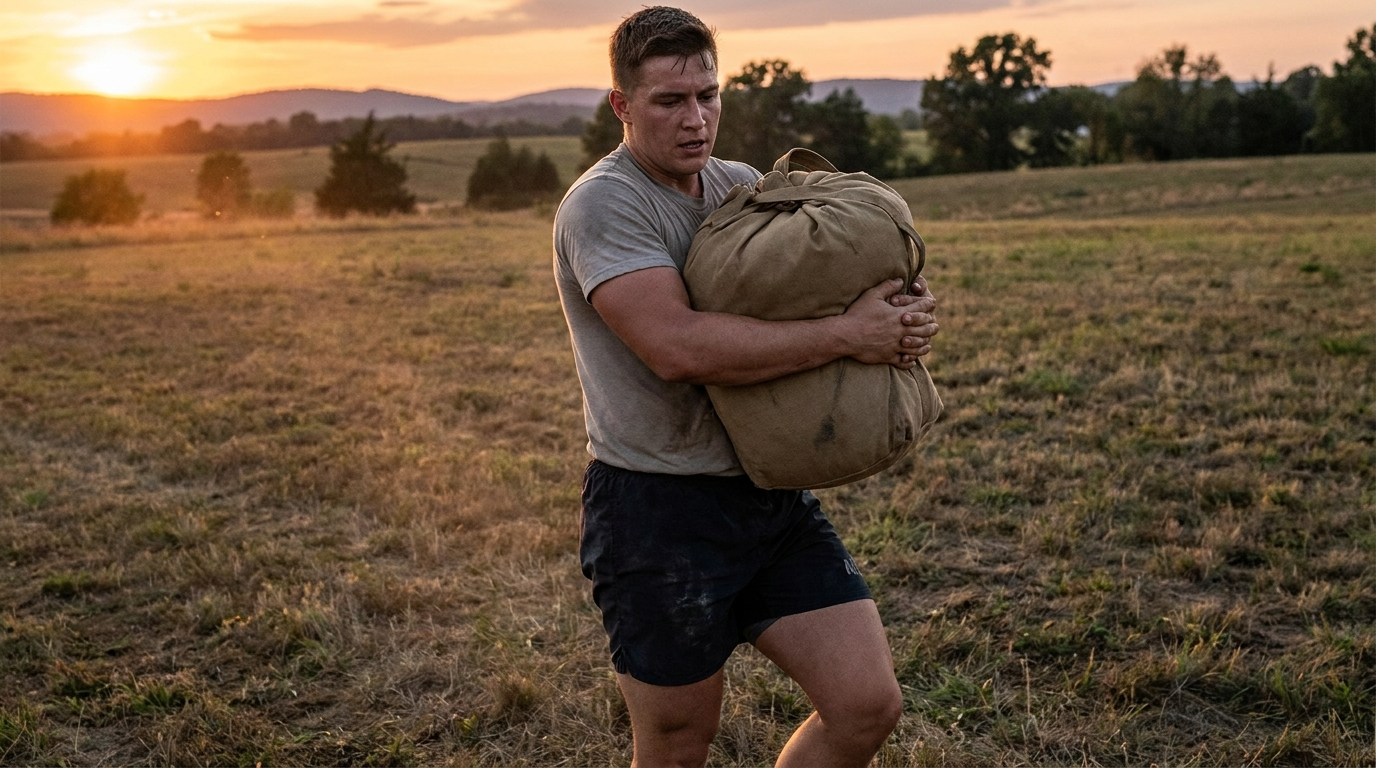
Pick it up, hug it, walk. Sets of 30 to 60 meters. Carries build the crushing trunk strength and work capacity that loaded movement demands, and they are brutally simple to program.
8. Sandbag over shoulder toss for reps
Continuous shouldering at a moderate weight is a conditioning engine: 10 to 20 reps, rest, repeat. Expect your heart rate to argue.
9. Get-up
Bag on one shoulder, get down to the ground and stand back up. Ugly, effective, and very transferable to real life.

Start here
Skirmish Training Sandbag
Adjustable 20 to 40 lb American-made bag, the right size for squats, lunges, presses, and conditioning, $89.
Shop now →How to Program Sandbag Training
For strength
Pick two or three movements, go heavy, keep reps at 3 to 6, and rest 2 to 3 minutes. Example: shouldering 5x3 per side, bear hug squat 4x5, deadlift and row superset 3x6.
For conditioning
Circuits of 3 to 5 movements at moderate weight, 8 to 15 reps each, minimal rest, for 15 to 25 minutes. Cleans, lunges, carries, and toss-over-shoulder reps stack together well. This style pairs perfectly with the running volume in our running endurance guide if you are building toward a military test; you can benchmark those scores anytime with the free military PT calculators.
Twice a week is enough
Two dedicated sandbag sessions per week, one strength-biased and one conditioning-biased, produce visible progress within a month while leaving room for running and barbell work.
3 Sandbag Workouts to Start With
1. Beginner circuit (20 minutes)
Five rounds, resting 60 seconds between rounds: 10 bear hug squats, 10 sandbag rows, 20 m bear hug carry, 10 alternating reverse lunges. Use a weight you could lift for twice the reps. This is the workout to repeat for the first month.
2. Strength day
Shouldering 5 x 3 per side, then bear hug squat 4 x 5, then sandbag deadlift 3 x 6. Rest 2 to 3 minutes between sets and go heavy enough that the last rep of each set is slow.
3. HYROX lunge prep
Four rounds: 400 m run, then 25 m walking sandbag lunges at your race weight. Rest 90 seconds. Add one round every two weeks until you can do six, which covers more than the 100 m of lunges you face on race day.
How Heavy Should Your Sandbag Be?
For most beginners, 20 to 40 pounds covers learning, conditioning circuits, and carries. Experienced lifters and anyone training for selection courses, fire academies, or heavy manual work should step up to a 60 to 80 pound bag for shouldering, squats, and short carries. Many athletes end up with both: a lighter bag for pace work and a heavy bag for strength.

When light stops being hard
Raider Sandbag Kit
Heavy-duty 60 to 80 lb kit built for shouldering, squats, and serious carry work, $139.97.
Shop now →HYROX Sandbag Lunges: Weights and How to Train Them
Sandbag lunges are the seventh of the eight HYROX stations: 100 m of walking lunges. Under the 2026/27 HYROX Singles rulebook the bag weighs 10 kg (about 22 lb) for Women, 20 kg (about 44 lb) for Men and Women Pro, and 30 kg (about 66 lb) for Men Pro.
Train at race weight. Our Skirmish sandbag (20 to 40 lb) covers the Women's 10 kg bag. The Raider kit comes with filler bags you load to any weight up to 80 lb, so one bag covers every division: 22, 44 or 66 lb. Lunges come after six runs and six stations, so practice them tired, straight off a run, the way workout 3 above does.
Want the full race build? Our free 8-week HYROX training plan covers all eight stations with gym and garage versions.
Frequently Asked Questions
How heavy is the HYROX sandbag?
10 kg (about 22 lb) for Women, 20 kg (about 44 lb) for Men and Women Pro, and 30 kg (about 66 lb) for Men Pro, carried for 100 m of walking lunges under the 2026/27 rulebook.
What is a good sandbag workout for beginners?
Five rounds of 10 bear hug squats, 10 sandbag rows, a 20 m bear hug carry and 10 reverse lunges, with 60 seconds of rest between rounds. Use a bag you could lift for twice the reps.
Can you build muscle with just a sandbag?
Yes, especially in the legs, back, trunk, and grip. Progressive overload still applies: add weight to the bag, add reps, or slow the tempo. A sandbag will not isolate small muscles like a cable stack, but for total-body strength it is outstanding.
Are sandbag workouts good for military prep?
Extremely. Odd-object lifting, shouldering, and loaded carries mirror the demands of combat fitness tests and selection events far better than machines do. Pair sandbag circuits with rucking and running for a complete base.
What is the best sandbag exercise for beginners?
The bear hug squat, then the bear hug carry. Both teach you to brace against a shifting load with almost no technique barrier.
Sandbag vs barbell: which is better?
Different jobs. Barbells are better for maximal strength because the load is stable and precisely incremental. Sandbags are better for conditioning, carries, and grip and trunk strength under awkward load. Serious programs use both.