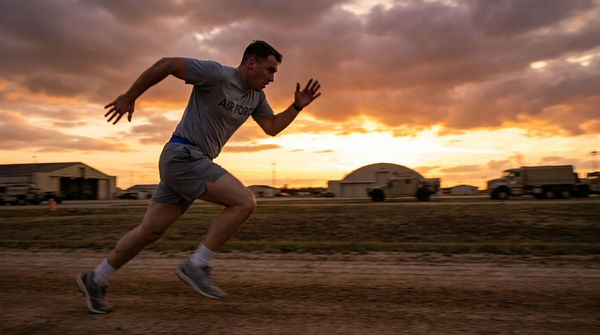

USMC Initial Strength Test (IST): Standards, Scoring, and How to Pass It Before Boot Camp

Before you ever step on the yellow footprints, the Marine Corps makes you prove you are ready to start training. That gate is the Initial Strength Test, or IST. Your recruiter administers it before you ship, and you will take it again during your first week at recruit training. Fail it, and you do not begin boot camp with your company.
The good news: the IST is very passable if you prepare. This guide covers the current minimums, the tougher enhanced standard for combat arms jobs, and how to train so the test feels like a warmup instead of a max effort.
What Is the Initial Strength Test?
The IST is a short pass or fail screening with three events: an upper body pull event, a core event, and a 1.5-mile run. It is not the full USMC PFT, which uses a 3-mile run and scores you on a 300-point scale. The IST simply confirms you can safely begin training. Recruits headed to physically demanding combat arms specialties also perform ammo can lifts as part of an enhanced version of the test.
Current IST Minimum Standards
Male minimums
- 3 pull-ups or 34 push-ups in 2 minutes
- Plank held for 40 seconds or longer
- 1.5-mile run in 13:30 or faster
Female minimums
- 1 pull-up or 15 push-ups in 2 minutes
- Plank held for 40 seconds or longer
- 1.5-mile run in 15:00 or faster
Enhanced IST for combat arms MOSs
If your contract points at infantry, reconnaissance, combat engineering, or another demanding specialty, expect a tougher screening that adds a 30-pound ammo can lift event, with 45 lifts in 2 minutes as the working standard, and leans on pull-ups rather than the push-up option. Later in training you will need to exceed minimums on the PFT and the Combat Fitness Test to keep that MOS.
Two important notes. First, these are floors, not goals. Recruiters consistently push applicants to show up well above minimums because your numbers usually drop under the stress and sleep deprivation of the first week. Second, the Corps is tightening standards across the board in 2026, including sex-neutral scoring for combat arms roles. Read our breakdown of the 2026 USMC fitness standards so nothing surprises you.

Built for pull-up progress
Battle Bands 3-Pack
Three resistance levels from 10 to 125 lbs for assisted pull-ups and push-up overload, $39.
Shop now →How to Train for Each IST Event
Pull-ups: build from wherever you are
If you cannot do 3 strict pull-ups yet, band-assisted reps are the fastest fix. Loop a resistance band over the bar, put a foot or knee in it, and do sets of 5 to 8 clean reps, moving to a lighter band every week or two. Add slow negatives, 3 to 5 seconds down, at the end of each session. Our pull-up progression guide for military selection lays out the full zero to twenty roadmap.
Core: train the plank directly
The plank rewards practice. Accumulate 3 to 4 minutes of total plank time per session in holds of 40 to 60 seconds, three days per week, and the 40-second minimum becomes trivial. Hanging knee raises and ab wheel style work build the anterior core strength that also carries over to ammo can lifts.
The 1.5-mile run: two quality days per week

Run at least three days per week: one interval day (6 to 8 rounds of 400 meters at goal pace with equal rest), one easy run of 20 to 35 minutes, and one timed or tempo effort. To pass at 13:30 you need 9:00 per mile pace, so train until 8:00 pace feels repeatable. Use the free military PT calculators to check where your current run time would score on the full PFT, and see our guide on increasing running endurance for the bigger picture.
A Simple 4-Week IST Prep Template
Train four days per week. Days 1 and 3: pull-up work, push-ups, and plank accumulation. Days 2 and 4: running, alternating intervals and easy distance. Finish two sessions per week with a fast 15 to 20 minute circuit of ammo can style presses, squats, and carries if you are headed to a combat MOS. Retest the full IST at the end of week 2 and week 4. When you can beat every minimum by 50 percent on a tired day, you are ready.

Core strength that transfers
Hanging Ab Straps V2
Made in the USA hanging straps for knee and leg raises that harden your plank and grip, $59.99.
Shop now →Test Day Tips
Sleep normally the two nights before, eat a light familiar meal 2 to 3 hours out, and warm up with 5 minutes of easy jogging plus a few submaximal pull-ups. Do not attempt a max plank warmup. Pace the first half mile of the run slightly slower than goal pace, then squeeze.
Passing the IST gets you through the door. For what comes next, read how long Marine boot camp is, week by week.
FAQ
What happens if I fail the IST at boot camp?
You will not start training with your company. Recruits who fail are typically placed in a physical conditioning platoon until they can pass, which extends your time at the depot. Showing up comfortably above minimums avoids this entirely.
Is the IST the same as the USMC PFT?
No. The IST is a short pass or fail entry screening with a 1.5-mile run. The PFT is the scored annual test with a 3-mile run, max set pull-ups, and a plank. Check your projected PFT score with the military PT calculators.
Can I do push-ups instead of pull-ups on the IST?
For the standard IST, yes: 34 push-ups for males or 15 for females in 2 minutes. But pull-ups are the currency of Marine Corps fitness, and combat arms applicants should plan on performing pull-ups, so train them from day one.
How long should I prepare before taking the IST?
If you are close to minimums, 4 weeks of focused work is usually enough. If you cannot yet do a pull-up or run 1.5 miles without stopping, give yourself 8 to 12 weeks and follow the progressions above.