
How to Train for the USMC CFT: Events, Scoring, and Training Plan

The USMC Combat Fitness Test is the Marine Corps physical fitness standard that the PFT does not cover. Where the PFT measures general fitness, the CFT measures combat-relevant conditioning: explosive movement, functional strength under load, and sustained high-intensity output. It is harder to fake, harder to cram for, and rewards Marines who train with purpose year-round. This guide breaks down all three events, how each one is scored, and how to train for them.
Before you start, run your numbers through the Marine Corps PFT calculator to check your current CFT scores and see what you need to hit first class or a perfect 300.
Training for the PFT as well? See our USMC PFT training guide, or compare every branch's standards in our military fitness test comparison. For the current requirements on both tests, review the USMC PFT and CFT standards.
The Three CFT Events
The CFT is three timed events run back to back in a single session, in boots and the utility uniform. It is normally administered in the second half of the year, opposite the PFT. Each event is scored 0 to 100, for a maximum of 300:
- Movement to Contact (MTC): An 880-yard run in boots and utilities. This is a sprint, not a distance run. It tests short-range aerobic speed and the ability to move fast in field conditions.
- Ammunition Can Lifts (ACL): A 30 lb ammo can lifted overhead as many times as possible in two minutes. Tests muscular endurance in the shoulders, arms, and core under sustained load.
- Maneuver Under Fire (MANUF): A 300-yard obstacle course done in pairs. Includes sprints, an agility section, buddy drag, ammo can carry, casualty carry, crawls, push-ups, and a grenade throw. Tests total body conditioning, coordination, and functional strength under fatigue.
How the CFT Is Scored
Each event converts your raw performance into a 0 to 100 score based on your age and gender, and the three scores add up to a 300-point maximum. You need a minimum of 40 points in every event to pass, and failing a single event fails the whole test. Your total also places you in a class and feeds your record, the same way a PFT score does.
That 40-point floor is the reason a lopsided athlete gets caught out. A fast runner who cannot press an ammo can, or a strong Marine with no sprint speed, can total a respectable number and still fail. Score every event separately before you decide what to train.
Event 1: Movement to Contact
The MTC is 880 yards, roughly two laps of a standard track, run as fast as possible. For males, a time under 2:28 earns 100 points. For females, under 3:02. At those paces, you are running faster than a 4:30 mile. This is a short, maximum-effort sprint event, not an aerobic test.
How to train it: Sprint intervals. Long slow runs do not transfer well to the MTC. What transfers is repeated short-distance speed work.
- 100-meter sprints at full effort with 90-second recovery: 8-10 reps, twice a week
- 400-meter repeats at faster than your goal MTC pace: 4-6 reps, once a week
- 800-meter repeats at goal pace to build lactate tolerance for the full distance
- Hills and stair sprints for leg power development
Running in boots periodically is important. Boot weight and ankle restriction change your stride mechanics. Do at least some of your sprint work in the gear you will test in.
Event 2: Ammunition Can Lifts
The ACL is two minutes of continuous overhead pressing with a 30 lb ammo can. The can must be lifted from shoulder height to full lockout overhead. For males, 82 reps earns 100 points. For females, 48 reps.
At 82 reps in 120 seconds, you are doing roughly one rep every 1.5 seconds without stopping. The limiting factor is shoulder endurance, not shoulder strength. A 30 lb can is not heavy. What breaks people is the sustained muscular demand without rest, and blowing out your reps in the first 30 seconds leaves you stalled for the last 90.
How to train it:
- Timed overhead pressing sets: Use a light to moderate dumbbell (25-35 lbs) and do timed sets of 45-60 seconds at full range of motion. Build up to continuous 2-minute sets.
- Kettlebell press endurance: High-rep kettlebell presses build the same overhead endurance pattern. Use a 25-35 lb bell.
- Pace training: Practice at the exact pace needed for your target score. 82 reps in 120 seconds is roughly 41 reps per minute. Train at that cadence so it feels controlled, not frantic.
- Grip and shoulder accessory work: Lateral raises, face pulls, band pull-aparts, and dead hangs build the stabilizer and grip endurance that keeps your shoulders from giving out in the final 30 seconds.
The Battle Bunker Battle Bands work well for shoulder stabilizer work and are easy to add at the end of any training session without adding gym time.
Event 3: Maneuver Under Fire
The MANUF is the most physically demanding event in the Marine Corps fitness testing program. It is a 300-yard course completed in pairs that includes:
- 25-yard sprint
- Agility movement through a marked course
- Buddy drag (pushing or dragging a casualty 10 yards)
- Ammo can carry across the field
- Fireman's carry (carrying a Marine for 75 yards)
- High crawl and low crawl sections
- Push-ups
- Grenade throw for accuracy
- Sprint to finish
For males, completing the course in under 2:21 earns 100 points. This is fast. Most of the course requires you to move at near-sprint speed while performing functional movements under accumulated fatigue. It is the event that separates well-rounded Marines from one-dimensional ones.
Training the MANUF requires training the specific demands:
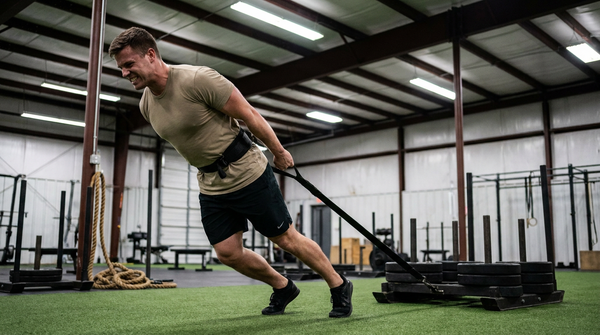
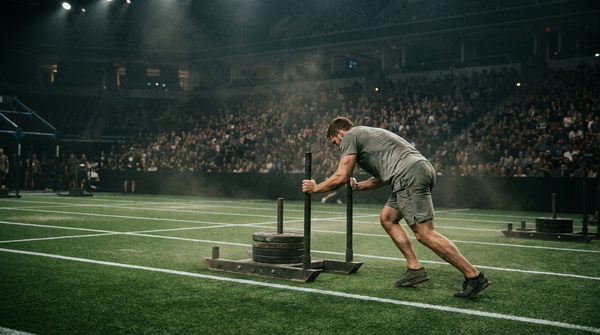
- Loaded carries: Farmer carries, sandbag carries, and partner-assisted carries build the functional strength and grip endurance the MANUF demands. The Battle Bunker Raider Sandbag is built for exactly this kind of functional carry training.
- Sprint conditioning under fatigue: Set up shuttle sprints that require you to sprint, perform a non-running movement (push-ups, a carry, a crawl), then sprint again. This teaches your body to accelerate after your heart rate is already elevated.
- Crawl mechanics: Practice high crawls and low crawls over distance. These are slow but exhausting. Getting efficient at them saves time on the course.
- Partner work: If possible, practice the buddy drag and fireman's carry with a training partner of similar size to your actual test partner. Technique makes these dramatically easier. A sloppy fireman's carry wastes energy and loses time.
For a station-by-station breakdown of the course, read our MANUF strategy guide.
8-Week CFT Training Plan
- Monday: MTC sprint work (8 x 100m), ACL timed sets (3 x 60 sec)
- Tuesday: MANUF simulation circuit, Loaded carries
- Wednesday: 400m repeats (5 reps at goal MTC pace), Shoulder accessory work
- Thursday: ACL volume (4 x 45 sec timed sets), Core and stability work
- Friday: Full MANUF run-through or shuttle sprint circuit
- Saturday: Easy run (20-30 min), Light shoulder work
- Sunday: Rest
In week 6, run a full simulated CFT. Check your times and rep counts against the calculator linked above to see where you stand and what needs the most attention in the final two weeks.
Common CFT Mistakes
Training the PFT and expecting it to carry over. The PFT and CFT test different things. A Marine who runs 18:00 for 3 miles is not necessarily prepared for 880-yard sprint pace or 2 minutes of ammo can lifts. CFT training needs to be specific.
Ignoring the ACL until the week before. Shoulder endurance takes time to build. Six to eight weeks of consistent ACL-specific training moves the needle. One week does not.
Skipping partner practice for the MANUF. The fireman's carry and buddy drag require technique that you learn by doing, not by reading. Practice them.
Not accounting for boots and utilities. Running in boots changes how your legs feel and how fast you can move. Do not show up to a CFT having done all your sprint training in running shoes.
Chasing a total instead of a floor. Every event needs at least 40 points. Train your weakest event first, then build the total.

Battle Bunker Raider Training Sandbag
Built for the carries, lifts, and loaded movement drills that CFT training demands. Made in the USA. If you are serious about MANUF prep, this is the training tool that transfers directly to test-day performance.
Shop Raider SandbagMarine Corps CFT FAQ
How is the CFT scored?
Three events, each worth up to 100 points, for a 300-point maximum. Scoring is adjusted by age and gender, and you need at least 40 points per event to pass.
How heavy is the ammo can?
30 pounds. You press it from shoulder height to full lockout overhead for max reps in two minutes.
How long is the Movement to Contact?
880 yards, about two laps of a standard track, run in boots and utilities.
How long is the Maneuver Under Fire?
Roughly 300 yards, run in pairs, combining sprints, crawls, carries, push-ups, and a grenade throw.
When do Marines take the CFT?
Generally in the second half of the year, opposite the PFT, though exact windows are set by the Marine Corps and your command.
What happens if you fail one event?
Failing any single event fails the entire test, even if your other two scores are high.
The Bottom Line
The CFT tests fitness that matters in the field. Sprint speed, overhead endurance, and the ability to move fast while carrying and dragging heavy loads. None of it is built by running long and doing push-ups. It requires specific training for each of the three events, done consistently for at least six to eight weeks before your test date.
Start by running your current estimates through the calculator, finding your weakest event, and prioritizing it. Train the MANUF specifically, build ACL endurance early, and put in the sprint work the MTC demands. That is how you score 300.
CFT standards and scoring are set by the Marine Corps and updated periodically. Confirm current requirements through official Marine Corps sources.