
What Is DEKA Fit? The Complete Guide to Spartan's Indoor Race
Short answer: DEKA is Spartan's indoor fitness racing format, built around ten standardized stations called DEKA Zones. DEKA FIT is the flagship version: you run 500 m before each of the ten zones, for 5 km of running plus the full circuit of work. Two shorter siblings share the identical zones, DEKA MILE (a tenth of a mile before each zone, one mile total) and DEKA STRONG (no running at all). Your score is the total time to complete the circuit, plus a recorded split for every individual zone, and Spartan calls that score your DEKA mark.
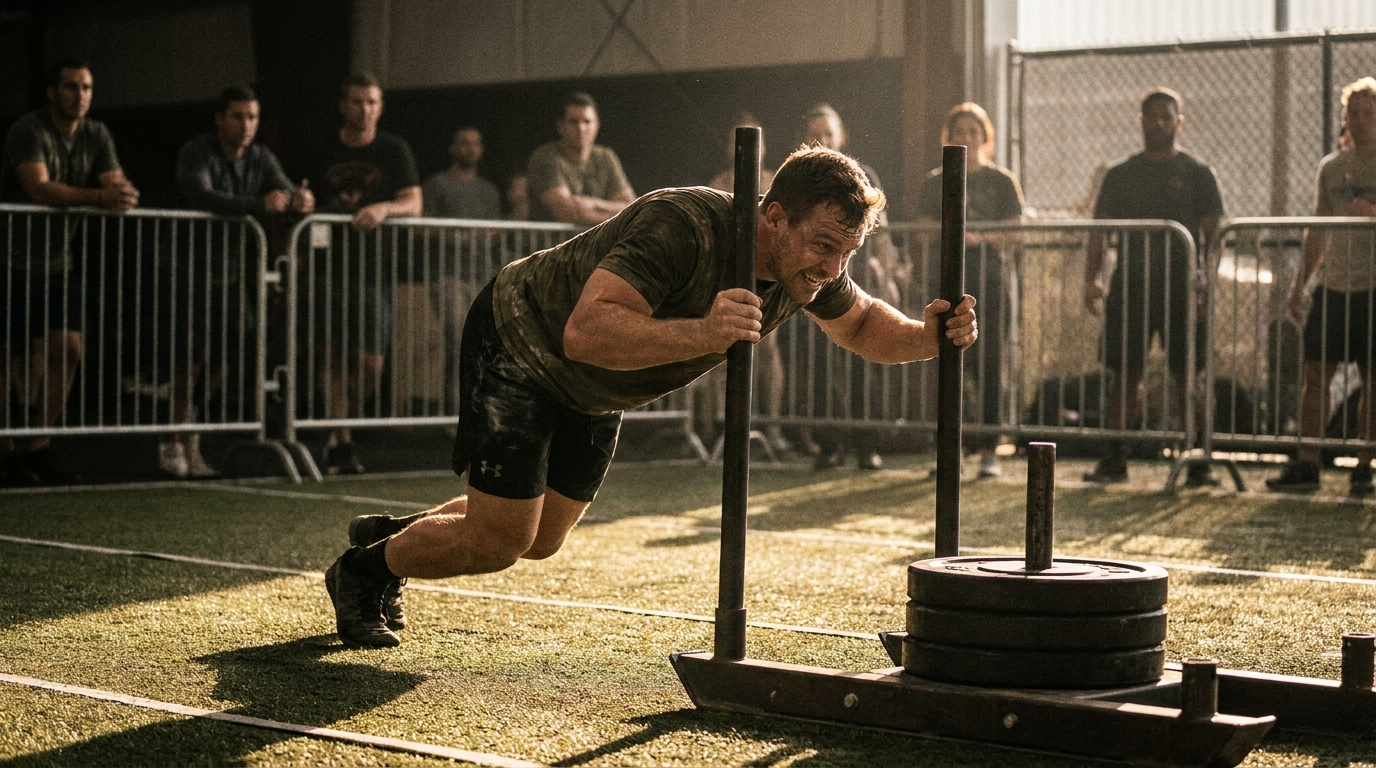
Spartan markets DEKA as the decathlon of fitness, and the framing is accurate. Unlike an obstacle race, nothing is a surprise. The zones are published, the reps are fixed, the loads are fixed, and the only variable is you. That is the appeal: a standardized test rather than an adventure, so the number you post actually means something the next time you post one.
The three DEKA formats
Every format uses the same ten zones. What changes is the running.
DEKA STRONG
Ten zones, zero running, straight from one station to the next. Spartan describes it as a fitness testing and assessment event and hosts it inside affiliate gyms rather than arenas. It is the cheapest and most common entry point. The DEKA STRONG listing we checked on spartan.com showed a $35 starting price, 0 km of running and an average duration of about twenty minutes. Both figures vary by host gym.
DEKA MILE
Ten zones with a short run before each one, roughly a tenth of a mile, adding up to one mile. Zones 4 and 8 are slightly modified: the med ball sit-up throw becomes a plain med ball sit-up, and the dead ball wall over becomes a dead ball shoulder over.
DEKA FIT
The flagship, and the version most people mean when they say "DEKA Fit." 500 m of running before each zone, 5 km total, usually staged in an arena. Zone 4 is the med ball sit-up throw and zone 8 is a dead ball wall over, so the FIT version of those two stations is genuinely harder than the gym versions. This is where elite heats, age group podiums, team and ruck categories and World Championship qualification live.
Spartan also runs two outliers: DEKA ULTRA, five complete circuits of DEKA FIT for 50 zones and 25 km of running, and DEKA ATLAS, a separate ten-zone barbell and dumbbell strength test with a 30 minute time cap. Completing STRONG, MILE and FIT in one calendar year earns the DEKA Trifecta.
The 10 DEKA Zones
These are the official zones, reps and loads as published on Spartan's DEKA equipment page. Loads listed under "Women" also apply to men in the 65 and over age group.
| Zone | Movement | Reps or distance | Men | Women |
|---|---|---|---|---|
| 1 | RAM alternating reverse lunge | 30 reps | 55 lb / 25 kg RAM | 33 lb / 15 kg RAM |
| 2 | Row | 500 m | Bodyweight | Bodyweight |
| 3 | Box jump or step over | 20 reps | 24 in / 60 cm box | 24 in / 60 cm box |
| 4 | Med ball sit-up (throw in DEKA FIT) | 25 reps | 20 lb / 9 kg | 14 lb / 6 kg |
| 5 | SkiErg | 500 m | Bodyweight | Bodyweight |
| 6 | Farmers carry | 100 m | Two 60 lb / 27.5 kg dumbbells | Two 40 lb / 17.5 kg dumbbells |
| 7 | Air bike | 25 calories | Bodyweight | Bodyweight |
| 8 | Dead ball shoulder over (wall over in DEKA FIT) | 20 reps | 60 lb / 27.5 kg dead ball | 40 lb / 17.5 kg dead ball |
| 9 | Sled push and pull | 100 m | Xebex XT3 Plus or XT4 with 160 lb added, resistance level 8, or Torque Tank level 3 | Xebex XT3 Plus or XT4 with 160 lb added, resistance level 7, or Torque Tank level 2 |
| 10 | RAM burpees | 20 reps | 44 lb / 20 kg RAM | 22 lb / 10 kg RAM |
Two things worth knowing. Spartan explicitly allows sand-filled implements, sandbags included, to replace dead balls at zone 8, provided they are weighed before the event. And any brand of box, med ball, dumbbell or kettlebell is permitted as long as the standard is met. Standards do get revised between seasons, so confirm the current numbers on spartan.com before building a program around them.
How scoring works
Your result is the total elapsed time for the whole circuit. But DEKA also records a split for each of the ten zones individually, and the leaderboards rank those zone-by-zone performances as well as the overall time. That is the most useful feature of the sport: after your first race you know exactly which two zones are costing you, rather than guessing.
The rules around a valid result are strict. To earn an official DEKA mark you must complete the entire course with no assistance. Failing a zone, or any reps within a zone, results in your timing chip being cut, which makes you ineligible for awards. You can still finish and collect the finisher tee, medal and hex. There is also a published weight tolerance: implements cannot be more than 2 lb under the standard for zones 1 through 6 and 8 through 10.
Heats split into Elite, Age Group, Team and Ruck. Spartan publishes thirteen age group ranges from a 10 to 13 youth division up through 70 plus. Ruck athletes carry a weighted pack, 30 lb for men and 20 lb for women, with weight vests and plate carriers banned. Notably, weight standards are the same for Elite and Open competitors, so the difference between those heats is the competition, not the load.
Who DEKA suits
It suits people who want a number rather than a story. If you have ever finished a workout with no idea whether you are actually fitter than you were in March, a fixed ten-zone circuit you can retest solves that.
It also suits strong athletes who are not yet runners. STRONG removes running entirely and MILE keeps it token, so you can race off a strength base without eight weeks of run volume first. Compare that with the 8 km inside a HYROX, and the entry barrier is obviously lower. We break that down properly in DEKA vs Hyrox.
Where it suits people less well: if you love the theatre of a big city arena weekend, DEKA STRONG in a local gym will feel small. And if your strength is pure aerobic running, four of the ten zones are loaded and three more are machines, so you will get exposed.

How to train for DEKA
Read the zone list again and the plan writes itself. Three zones are machines. Four are loaded carries, lunges or burpees. One is a sled, one is a box, one is core.
Train the RAM position, not just the movement. Zones 1 and 10 both use a Spartan RAM roller held against the chest, at the very start and the very end of the circuit. That front-loaded position wrecks your breathing. Bear hug reverse lunges and weighted burpees at similar loads build the exact tolerance you need, and a sandbag substitutes well.
Do not neglect the ergs. Zones 2, 5 and 7 are a 500 m row, a 500 m ski and 25 calories on the air bike. Thirty percent of the circuit is machine work, and that is where undertrained athletes bleed the most time because they go out too hard. Practice each at race distance until you know the split by feel.
Build grip before it builds you. The 100 m farmers carry at 60 lb per hand lands at zone 6, halfway through, and if your grip fails there it also fails at zones 8 and 9. Heavy carries twice a week for eight weeks fixes this faster than anything else.
Rehearse the transitions. In DEKA FIT there is 500 m of running between every zone. That is compromised running, and it is a skill. Our Hyrox training plan works as a chassis for DEKA FIT because the run-work-run pattern is identical.
A simple week: two zone simulations, two strength days built on lunges, hinges and carries, and two or three easy runs. Six weeks out, time every zone individually so you have baseline splits.
What equipment helps
You need a gym with a rower, a SkiErg and an air bike to train zones 2, 5 and 7 honestly. Machine access is the one thing you cannot fake at home. Our directory of Hyrox gyms by city is a reasonable shortcut, since gyms carrying that equipment for HYROX carry it for DEKA too. Spartan also publishes a partner gym list.
For the rest, a 24 inch box, a med ball, heavy dumbbells and one heavy bag cover zones 1, 3, 4, 6, 8 and 10. The bag is the most efficient purchase of the lot: it substitutes for the RAM, it is an explicitly permitted replacement for the dead ball at zone 8, and dragged on grass it stands in for the zone 9 sled. Six of ten zones off one implement, which is why our training sandbags show up in nearly every hybrid program we write.

SIX ZONES, ONE IMPLEMENT
Raider Training Sandbag Kit
Adjustable from roughly 60 to 80 lb, so it hits the 60 lb dead ball standard for zone 8, covers RAM-style lunges and burpees for zones 1 and 10, and drags on grass as a zone 9 sled substitute. $139.97.
Shop now →Frequently asked questions
What is a DEKA mark?
Your DEKA mark is your official recorded score for an event: the total time to complete the ten zones plus the running for that format. To earn one you must complete the entire course unassisted with every rep at the prescribed standard. It exists so you can set a mark, train, then beat it.
How long does DEKA FIT take?
Spartan does not publish a single official finishing time. The one concrete figure we could verify was on a DEKA STRONG listing, which showed an average duration of about twenty minutes for the zones alone. DEKA FIT adds 5 km of running to that circuit, so budget considerably longer, and check the public leaderboards for real times in your age group.
Do I need a DEKA affiliate gym to compete?
No, but DEKA STRONG and DEKA MILE events are hosted by affiliate fitness facilities, so finding one near you is the practical route in. DEKA FIT runs at larger arena venues. Spartan maintains a partner gym directory and an event finder for both.
Can I scale the movements if I cannot do them all?
Scaling happens through categories rather than freelancing. The youth 10 to 13 division and the 65 and over age groups race published lighter loads, and team heats split the zones between two or four people. To earn an official mark in your own category you have to complete every zone at that category's standard, so ask the host gym what options exist before you register.
What is the difference between DEKA FIT and DEKA STRONG?
Running, venue and two zone variations. FIT adds 500 m of running before every zone for 5 km total and usually runs in an arena. STRONG has no running and takes place inside a gym. FIT also uses the harder versions of zones 4 and 8, the med ball throw and the dead ball wall over. The other eight zones are identical.
Related reading
- Sled Training: Push, Drag, and Pull Workouts That Build a Bigger Engine
- Farmers Carry: Benefits, Form, and Workouts
- Sandbag Workout: Best Exercises and Routine
- What Size Sandbag Should You Get?
Zones, loads, divisions and prices are revised between seasons. Every number above was taken from spartan.com or the official DEKA support site at the time of writing. Confirm the current standards for your division and event before you race.