

DEKA vs Hyrox: How the Two Hybrid Fitness Races Compare
Short answer: HYROX is a single fixed race, eight 1 km runs alternating with eight functional stations, held in arenas and identical everywhere in the world. DEKA is Spartan's indoor racing family built on ten standardized stations called DEKA Zones, sold in three core formats: DEKA STRONG with no running, DEKA MILE with a mile of running, and DEKA FIT with a 5K. HYROX is the longer and far more running-heavy test, and it takes most people well over an hour. DEKA STRONG sits at the other end, an all-out fitness benchmark you can finish in roughly twenty minutes at a local affiliate gym.
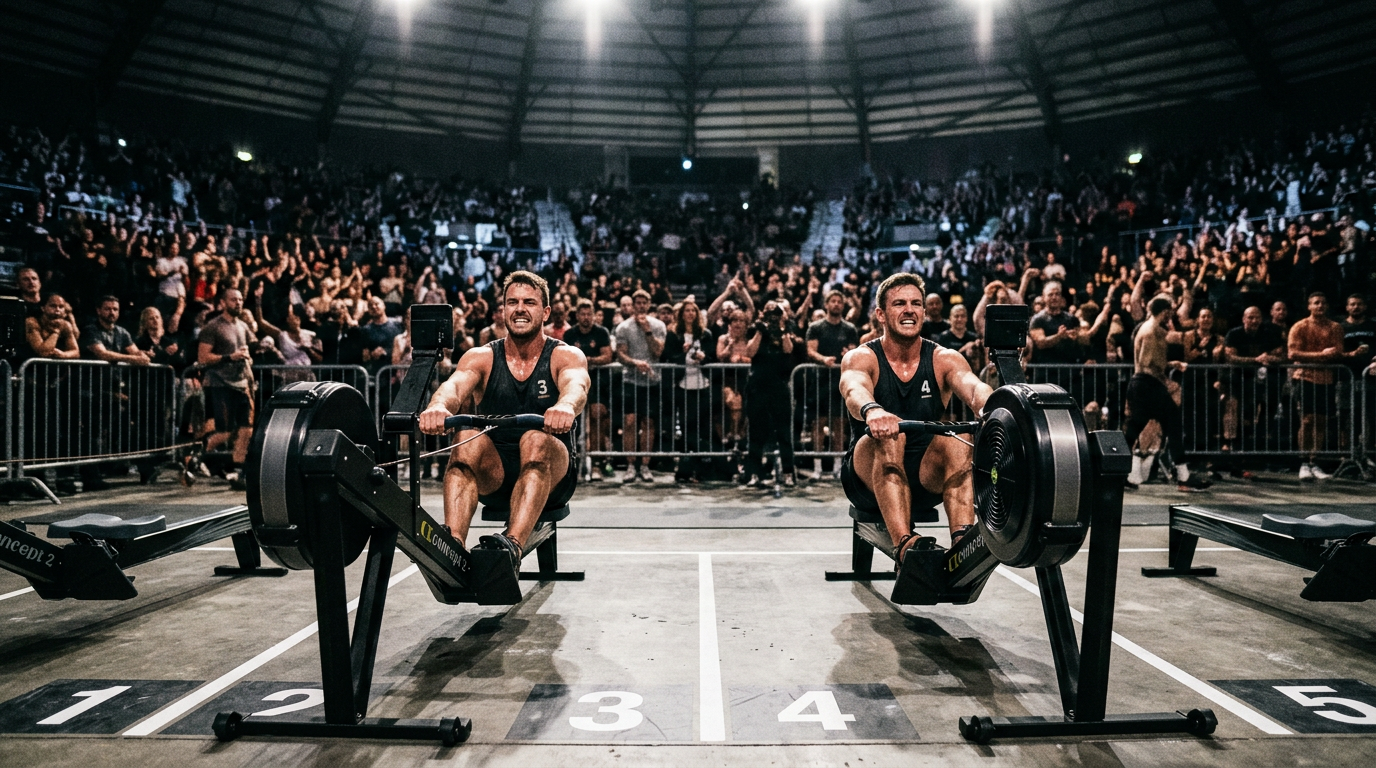
Both get filed under "hybrid fitness racing" and the overlap is real: sleds, ergs, loaded carries, lunges, a clock. But they are built to answer different questions. HYROX asks how well you run when you are already wrecked. DEKA asks how much work you can move through a fixed set of stations. Knowing which question you actually want answered is most of the decision.
What HYROX is
One format, one distance, everywhere. You run 1 km, complete a station, run 1 km, complete the next, eight times through, for 8 km of running in total. The stations always come in the same order:
- 1,000 m SkiErg
- 50 m sled push
- 50 m sled pull
- 80 m burpee broad jump
- 1,000 m row
- 200 m farmers carry
- 100 m sandbag lunges
- 100 wall balls
Loads change by division. Open, Pro, doubles and relay categories carry different sled weights, sandbag weights and wall ball targets, and HYROX revises them between seasons, so pull the current rulebook for your division from hyrox.com rather than trusting a number screenshotted off Instagram.
What HYROX sells is comparability. Because the course never changes, a time set in Dallas means the same thing as a time set in Hamburg, and the global leaderboard is the entire point. The tradeoff is that it is a long day. Unless you are genuinely fast, plan for an hour or more of continuous work, and understand that the deciding skill is compromised running: holding a pace after your legs have been cooked by wall balls and lunges.
What DEKA is
DEKA is Spartan's indoor fitness racing format, and its organizing idea is the ten DEKA Zones. The zones themselves do not change between formats. What changes is how much running gets bolted onto them. Spartan's own support site actually lists five event types, so if you have only ever heard of three, here is the fuller picture.
DEKA STRONG
Ten zones, zero running, straight from one station to the next in a gym environment. Spartan describes it as a fitness testing and assessment event, and it is the most accessible entry point in the family. The DEKA STRONG event listing we checked on spartan.com showed 0 km of running, a $35 starting price and an average duration of about twenty minutes. Both price and duration vary by host gym, so confirm on the specific event page.
DEKA MILE
Ten zones with a short run before each one, roughly a tenth of a mile, for one mile in total. Zones 4 and 8 are slightly modified compared with DEKA FIT: the med ball throw becomes a straight med ball sit-up, and the dead ball wall over becomes a dead ball shoulder over.
DEKA FIT
The flagship. 500 m of running before each zone, 5 km in total, usually staged in an arena rather than a gym. This is where the elite heats, age group awards, team and ruck categories and World Championship qualification live.
Spartan also runs DEKA ULTRA, which is five full circuits of DEKA FIT for 50 zones and 25 km of running, and DEKA ATLAS, a completely separate ten-zone barbell and dumbbell strength test with a 30 minute time cap. Both are documented on the DEKA competition formats page.
DEKA vs HYROX, side by side
| HYROX | DEKA | |
|---|---|---|
| Format | One race, one distance, unchanged worldwide | A family of formats sharing the same ten zones |
| Event structure | 8 runs alternating with 8 stations | 10 zones, with running added or removed depending on format |
| Running volume | 8 km, always | STRONG 0 km, MILE 1 mile, FIT 5 km, ULTRA 25 km |
| Stations | SkiErg, sled push, sled pull, burpee broad jump, row, farmers carry, sandbag lunges, wall balls | RAM reverse lunges, row, box step overs, med ball sit-ups, ski, farmers carry, air bike, dead ball overs, sled push and pull, RAM burpees |
| Scoring | Total elapsed time, chip timed, global leaderboard | Total time plus a split for every individual zone, recorded as your DEKA mark |
| Where you compete | Large arenas and convention centres, major cities | Affiliate gyms for STRONG and MILE, arenas for FIT |
| Divisions | Open, Pro, doubles, relay, plus age groups | Elite, age group, 2 and 4 person teams, ruck. Age groups run from 10-13 up to 70+ |
| Typical cost | Varies by city and how early you enter. Confirm on the event page | DEKA STRONG listings we checked started at $35. FIT arena events cost more |
Who each one suits
Choose HYROX if you already run, or want to. Half the race is running, and the winners are almost always the better runners with adequate strength rather than the stronger athletes with adequate running. It also suits people who want the event to be an occasion: big venue, crowds, a proper start line, a reason to travel.
Choose DEKA if you want a benchmark rather than an occasion. The zones are fixed and every zone gets its own split, so retesting DEKA STRONG every couple of months gives you a genuinely useful number instead of a vague feeling. It also suits athletes who are strong but not yet runners, anyone who wants a cheap and local first race, and people managing knees or shins that cannot absorb 8 km of hard running yet. The ladder from STRONG to MILE to FIT is a real progression, and completing all three in a calendar year earns the DEKA Trifecta.

Can you train for both?
Yes, and more easily than you might expect, because the two share most of their physical demands. Both punish weak grip, weak quads, sloppy hip hinge mechanics and a small aerobic engine. Both put a sled and a long loaded carry in front of you. Both reward the ability to keep working while your heart rate sits near threshold and your forearms are screaming.
The honest differences come down to three things. First, running volume: HYROX demands a real running base, DEKA STRONG demands none. Second, the machines: DEKA leans on the air bike, which HYROX does not use at all. Third, the implements: HYROX uses a sandbag for its 100 m lunges, while DEKA uses a weighted RAM roller for both its lunges and its burpees, plus a dead ball for the wall overs.
A practical approach is to build one base and specialise only in the last six weeks. Run three times a week year round, keep two strength days, and add one weekly session that mimics whichever race is next on the calendar. Our Hyrox training plan works as a chassis for either, since the compromised running and station work transfer directly. If you are hunting for somewhere to train, our directory of Hyrox gyms by city is a decent proxy for DEKA too, because the equipment overlap is heavy.
The single piece of kit that covers the most ground across both is a heavy bag. Sandbag lunges, bear hug carries, shouldering and sled-substitute drags on grass all come off the same implement, which is why our training sandbags and this sandbag workout sit at the centre of most of our hybrid programming.

ONE BAG, BOTH RACES
Raider Training Sandbag Kit
Adjustable from roughly 60 to 80 lb, which covers Hyrox sandbag lunges at race weight and doubles as a sled substitute for DEKA zone 9 drags on grass or turf. The cheapest way to train the loaded work for either race at home. $139.97.
Shop now →Free download
The 8-Week HYROX Training Plan
Four sessions a week, every station covered, the official 2026/27 weights, and garage swaps for the sled and SkiErg. Free PDF to your inbox.
Get the free planFrequently asked questions
Is DEKA easier than HYROX?
DEKA STRONG is shorter, not easier. Twenty minutes with no running is a different kind of suffering to ninety minutes with 8 km of it: higher intensity, less pacing, more raw strength endurance. DEKA FIT, which adds a 5K to the same ten zones, closes a good deal of the gap. And DEKA ULTRA, at 50 zones and 25 km, is a longer day than a HYROX. Compare the specific format, not the brand name.
Which is better for a first hybrid race?
DEKA STRONG, in most cases. It is inexpensive, usually local, over quickly, and it does not require you to have built a running base first. If you finish and want more, DEKA MILE and DEKA FIT are the obvious next rungs, and HYROX becomes a reasonable target twelve to sixteen weeks after that.
Do DEKA and HYROX use the same equipment?
Partly. Both use a rower, a SkiErg, a sled and a heavy loaded carry. After that they diverge. DEKA adds an air bike, a 24 inch box, a med ball, a dead ball and the Spartan RAM roller, and its farmers carry is 100 m with dumbbells, listed as 60 lb per hand for men and 40 lb per hand for women on the official DEKA equipment page. HYROX adds burpee broad jumps, wall balls and sandbag lunges, and its farmers carry runs 200 m with kettlebells.
Can you qualify for a world championship in both?
Yes. Both run qualification pathways into an annual world championship, and both stratify by age group as well as by elite status. DEKA publishes thirteen age group ranges, from a 10 to 13 youth division up through 70 plus, alongside elite, team and ruck heat types. Qualification standards move season to season, so check the current rules on spartan.com and hyrox.com before planning a whole year around them.
Related reading
- Sled Training: Push, Drag, and Pull Workouts That Build a Bigger Engine
- Farmers Carry: Benefits, Form, and Workouts
- Hyrox Race Day Preparation Guide
- What Size Sandbag Should You Get?
Race formats, loads, divisions and entry prices change between seasons. Everything above was checked against spartan.com, the official DEKA support site and hyrox.com at the time of writing. Confirm the current standards for your division before you race.