
Farmers Carry: Benefits, Form, Weight and HYROX Standards

Pick up something heavy in each hand. Walk. That is the farmers carry, and its simplicity hides how much it delivers. Few exercises build grip, core stability, trap and shoulder strength, and conditioning at the same time, with almost zero technique barrier and almost zero injury risk. If you only added one movement to your training this year, this would be a strong pick.
What Is the Farmers Carry?
The farmers carry, also called the farmers walk, is a loaded carry where you hold a weight in each hand at your sides and walk for distance or time. Strongman competitors use purpose-built handles, but dumbbells, kettlebells, trap bars, and even sandbags all work. It trains the body exactly the way life loads it, which is why coaches call it the most functional exercise in the gym.
Farmers Carry Benefits
Grip strength that transfers everywhere
Your hands are the limiting factor in deadlifts, pull-ups, rows, and rucking. Heavy carries train crushing grip under time, and that strength shows up in every pull you do. Pair carries with direct forearm exercises to round out your grip work. If your grip currently fails before your legs on deadlifts, carries are the fix, alongside the strategies in our guide to the best lifts to use lifting straps on.
A core that resists, not crunches
Your trunk's real job is preventing motion under load. Carries force your abs, obliques, and lower back to lock your spine in place while your limbs move, the same anti-flexion and anti-lean demand you face carrying gear, groceries, or a ruck.
Traps, shoulders, and posture
Holding heavy weight at your sides is a loaded shrug isometric. Combined with the tall walking posture the exercise forces, carries build the upper back and improve the rounded posture most desk workers carry into the gym.
Conditioning without joint punishment
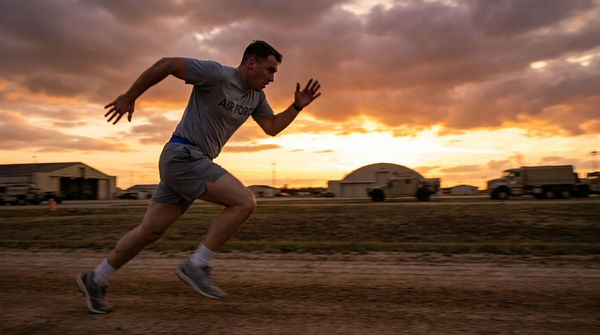
Heavy carries spike your heart rate fast, but the movement is just walking. That makes them one of the safest ways to build work capacity on tired legs, and a favorite finisher for military athletes prepping for events like the Sprint-Drag-Carry.
The research lines up with the gym folklore: an NSCA Coach article on loaded carries notes they can build anaerobic endurance, back endurance and grip strength, and a 2009 study by McGill and colleagues concluded that loaded carrying can add to traditional lifting-based strength programs.
How to Do the Farmers Carry
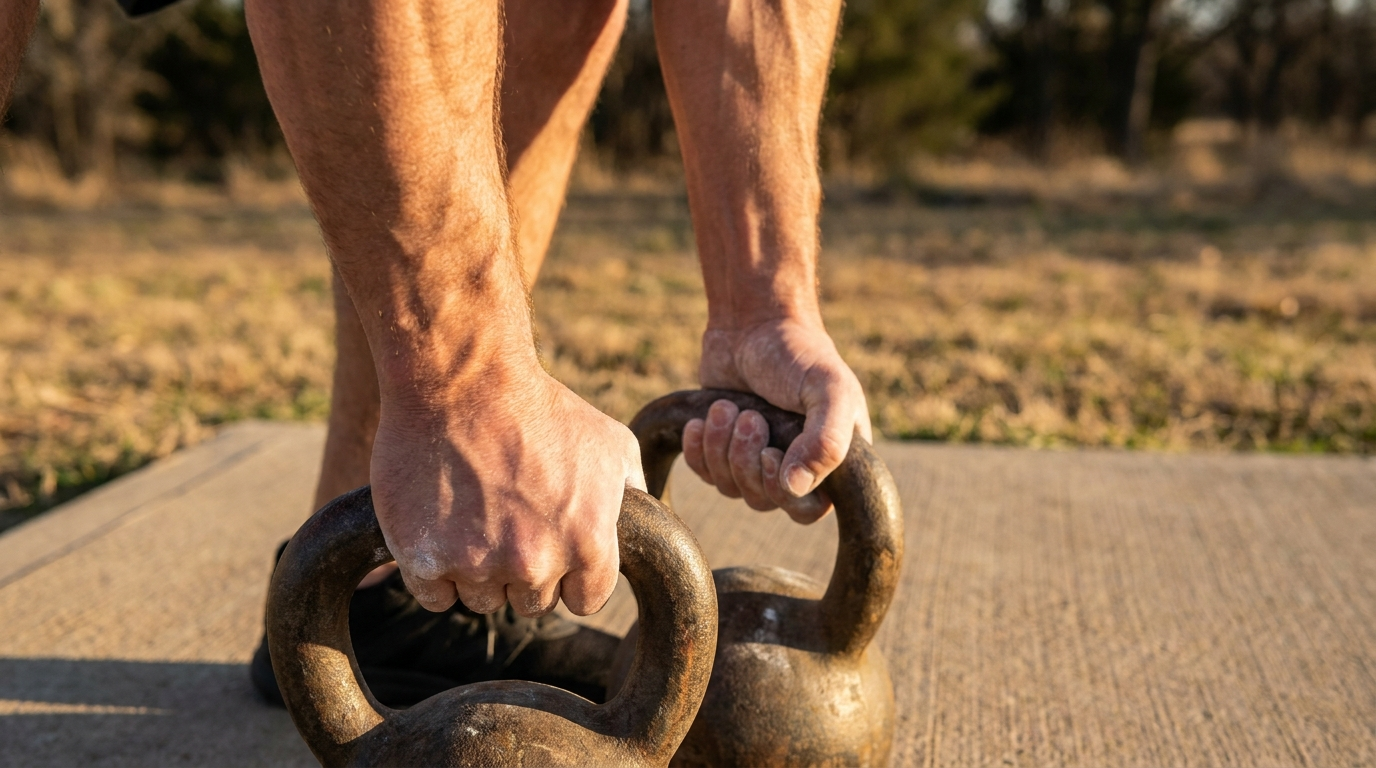
Set two weights beside your feet. Hinge down with a flat back, grab the handles, and stand up as if deadlifting. Pull your shoulders back and down, brace your core, and look ahead, not at the floor. Walk with quick, controlled steps, keeping the weights from swinging. Set the weights down with the same flat back you picked them up with.
Common mistakes to avoid: leaning to one side, shrugging your shoulders up to your ears, taking long slow strides that let the load swing, and letting your chin poke forward. Tall, tight, and quick is the pattern.
How heavy should a farmers carry be?
A strong starting target is half your body weight per hand for 30 to 40 meters. Beginners should start around a quarter of body weight per hand and build up. When a load lets you walk more than 60 meters easily, it is warm-up weight.
Farmers Carry Standards: HYROX and Military Tests
In a HYROX race the farmers carry is the sixth of eight stations: 200 meters with a kettlebell in each hand. The 2026/27 rulebook sets these weights per hand:
| HYROX division | Weight per hand |
|---|---|
| Women | 16 kg (about 35 lb) |
| Women Pro and Men | 24 kg (about 53 lb) |
| Men Pro | 32 kg (about 71 lb) |
Doubles uses 16 kg for Women, 24 kg for Men, Mixed and Women Pro, and 32 kg for Men Pro. Relay teams carry 16 kg (women) or 24 kg (men).
The rules that catch people out: both bells stay in your hands with your arms extended at your sides while you move; you can set them down to rest as long as they do not move forward; in Doubles the bells cannot be passed forward to your partner; and at the end the bells go back in the box with the handles upright, or you take a 30-second penalty. Under the 26/27 rulebook a missed lap is a disqualification (it was a 3-minute penalty in 25/26). Gloves are allowed and event-provided chalk is permitted on this station, but straps are not on the list of permitted items, and anything not listed is prohibited.
Army AFT: the Sprint-Drag-Carry includes a farmers-style carry with two 40 lb kettlebells, 25 meters out and 25 meters back, as one of its five 50-meter shuttles. Drop the bells and you resume from the spot where they fell. Train it with our Sprint-Drag-Carry guide and check your score on the AFT calculator.
Marine Corps CFT: Maneuver Under Fire includes a carry with two 30 lb ammunition cans. Score the whole test on our USMC PFT and CFT calculator.
Sources: HYROX 26/27 Singles rulebook, HYROX 26/27 Doubles rulebook, army.mil Army Fitness Test, marines.mil on the CFT and its Maneuver Under Fire walkthrough.
Kettlebell, Dumbbell, Trap Bar and Sandbag Carries
Kettlebells are what HYROX and the Army AFT use, so train with them if you race or test. Dumbbells carry the same way and usually come in finer jumps. A trap bar puts both handles on one frame. A one-hand suitcase carry adds an anti-lean challenge; the NSCA notes that a load in one hand puts more load on the spine than the same load split between two hands, so build it up gradually.
Sandbags turn it into a different carry: hug the bag to your chest or load it on a shoulder and your upper back and trunk do the work your grip did. Our Skirmish training sandbag (20 to 40 lb) and Raider training sandbag kit (60 to 80 lb) are made in the USA and built for carries, and our sandbag carry workout puts them to use.
Farmers Carry Workouts
For strength, do 4 to 5 sets of 30 to 40 meters with a load that makes the last 10 meters a fight, resting 2 minutes between sets. For conditioning, use a medium load and carry 40 meters at the top of every minute for 10 minutes. For grip specialization, use one heavy carry to failure at the end of your pull day. Carries also slot naturally into mixed circuits, like the ones in our sandbag carry workout, and they complement the loaded movement patterns in our grip and pulling guide.
One honest note about grip: on max-effort carry sets and heavy deadlift sessions, your hands will give out before the muscles you are trying to train. That is when straps earn their place, letting you push traps, core, and legs past what your grip allows on its own. Racing HYROX? Straps are not allowed on race day, so keep some strapless carry work in every week.

Grip insurance
Battle Straps
Premium padded lifting straps for heavy carries, deadlifts, and rows, $15.49.
Shop now →Frequently Asked Questions
How heavy is the HYROX farmers carry?
Two kettlebells over 200 meters: 16 kg per hand for Women, 24 kg for Women Pro and Men, and 32 kg for Men Pro under the 2026/27 rulebook.
Can you put the kettlebells down during the HYROX farmers carry?
Yes. You can set them down to rest as long as they do not move forward. Missing a lap is a disqualification under the 26/27 rulebook.
Can you use straps or chalk on the HYROX farmers carry?
Gloves are allowed and event-provided chalk is permitted on the farmers carry. Straps are not on the rulebook's list of permitted items, and anything not listed is prohibited, so train your raw grip.
How heavy are the kettlebells in the Army AFT Sprint-Drag-Carry?
Two 40 lb kettlebells, carried 25 meters out and 25 meters back as one of the five 50-meter shuttles.
What muscles does the farmers carry work?
Forearms and grip, traps, shoulders, abs and obliques, glutes, and calves. It is a whole-body exercise disguised as a walk.
How far should I walk on a farmers carry?
30 to 40 meters per set is the sweet spot for strength. Go shorter and heavier for grip focus, longer and lighter for conditioning.
Can I do farmers carries every day?
Light and moderate carries recover quickly and can be done most days. Save maximal carries for once or twice per week, the same way you would treat heavy deadlifts.
Do farmers carries build muscle?
Yes, especially in the traps and forearms, which spend the entire set under isometric tension. Pair carries with progressive overload, walking a bit farther or a bit heavier each week. To gauge how far you have come, test your grip and compare it against grip strength norms for your age.
Training for a military PT test? Loaded carries build the grip and trunk endurance those events demand. Check your current scores with the free military PT calculators.