
Zercher Squat: Benefits, Proper Form, and How to Program It

The zercher squat looks like a punishment and feels like one the first time you try it. You cradle the barbell in the crooks of your elbows, hug it against your torso, and squat. No rack position, no back loading, just you and a bar trying to fold you in half. Lifters who stick with it find it builds a kind of strength that shows up everywhere: carrying, lifting off the floor, rucking, grappling, and every awkward object you will ever pick up.
What Is the Zercher Squat?
Named after 1930s strongman Ed Zercher, the zercher squat is a front-loaded squat variation where the bar sits in the bend of your elbows instead of on your back or shoulders. Because the load sits in front of your center of mass, your upper back, abs, and biceps fight the entire set to keep you upright. The result is a squat that doubles as a brutal core and upper-back exercise.
Zercher Squat Benefits
Upright posture and a bulletproof upper back
The front load forces a vertical torso. Round forward even slightly and the bar wins. Over time this builds the exact mid-back and core stiffness that protects your spine on deadlifts and heavy carries.
Direct carryover to real-world strength
Almost nothing you lift in real life sits comfortably on your shoulders. Sandbags, furniture, casualties in a fireman drag, all of it gets hugged against your chest. The zercher pattern is the closest barbell match to that reality, which is why it is a staple for military athletes and strongman competitors.
Deep squat mobility without ankle gymnastics
Most lifters can hit a deeper, cleaner squat position in the zercher than in a back squat because the counterbalance of the front load lets you sit between your knees with a tall chest.
A core workout you cannot cheat
There is no bracing shortcut. Every rep demands a hard 360-degree brace, the same skill that carries over to every other lift you train.
How to Do the Zercher Squat
Set the bar in a rack at about stomach height. Slide your arms under the bar so it rests in the crooks of your elbows, then clasp your hands together and pull the bar tight to your torso. Step back, set your feet slightly wider than shoulder width, brace hard, and sit down between your knees. Keep your elbows up and chest tall, then drive through your whole foot to stand.
Three cues fix most problems: hug the bar like you are trying to bend it around your chest, keep your elbows lifted so the bar cannot roll down your forearms, and breathe and brace before every rep, not during it.
Does the zercher squat hurt your arms?
The bar in the elbow crease is uncomfortable at first. Wrap the bar in a towel or pad while you build tolerance, or use a sandbag instead, which spreads the load across a wider surface and removes the pain problem entirely.
The Sandbag Zercher: The Most Practical Variation
A sandbag zercher squat or carry gives you every benefit of the barbell version with a friendlier learning curve, and it adds an instability component a barbell cannot match because the load shifts on every step. If your training leans functional or military, the sandbag version is arguably the better default. It pairs perfectly with the loaded movement patterns in our sandbag workout guide and the conditioning circuits in our sandbag carry workout.

Made in the USA
Skirmish Training Sandbag
Adjustable 20 to 40 lb sandbag built for zercher squats, carries, and ground-to-shoulder work, $89.
Shop now →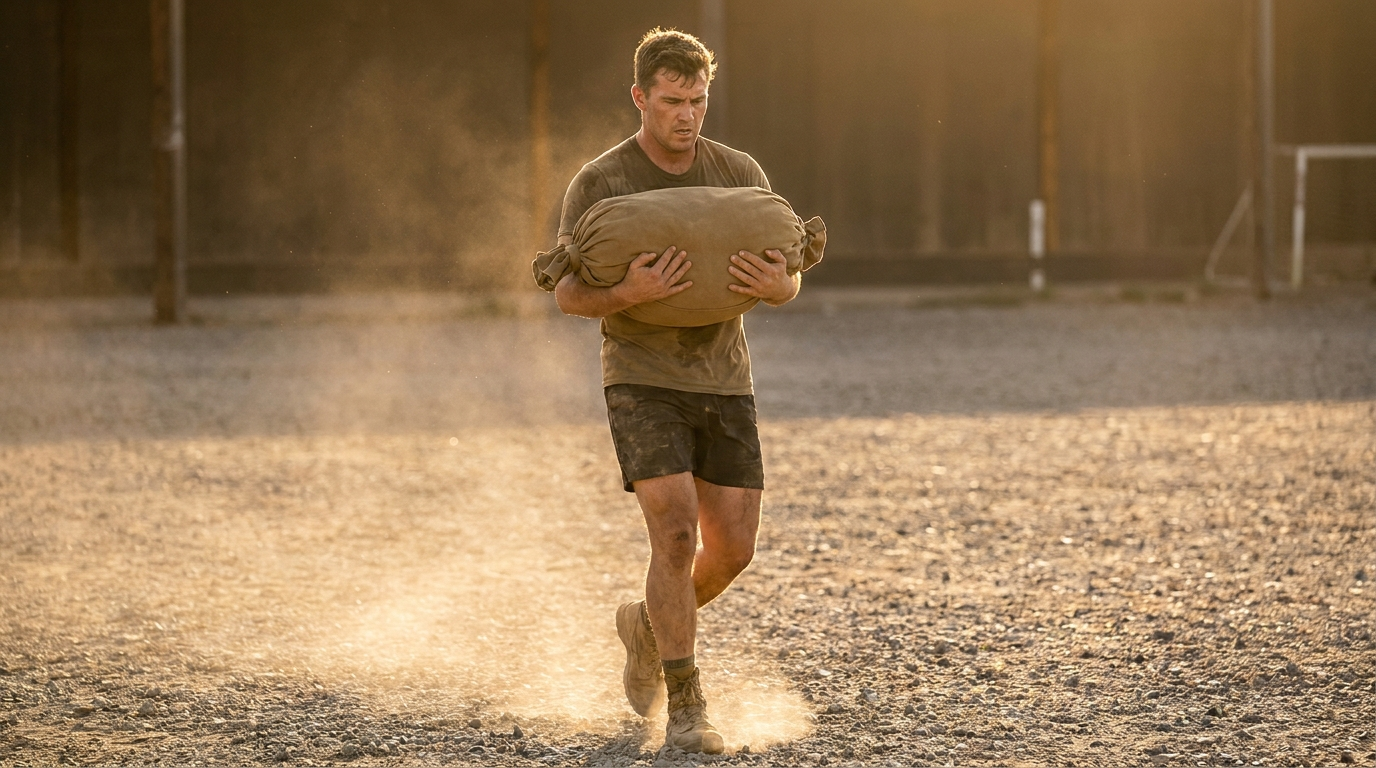
How to Program the Zercher Squat
For strength, work in the 4 to 8 rep range for 3 to 4 sets, once per week, either as your second lower-body movement or as a main lift during a back squat deload. For conditioning and work capacity, use a sandbag: 8 to 12 zercher squats at the top of every minute for 10 minutes, or zercher carries for 40 to 50 meters between sets of another exercise. Hybrid athletes can slot zercher work directly into the weekly template from our hybrid training guide.
Training for a military fitness test? Zercher squats and carries build the trunk strength that pays off in events like the Sprint-Drag-Carry. Score yourself on the free military PT calculators to see where you stand.
Frequently Asked Questions
What muscles does the zercher squat work?
Quads and glutes do the squatting, while your abs, obliques, upper back, and biceps work overtime to hold the load. It is closer to a whole-body lift than a leg exercise.
Is the zercher squat better than the front squat?
Neither is better, they solve different problems. The front squat allows more load and suits Olympic lifting. The zercher demands less wrist and shoulder mobility, hits the upper back harder, and transfers more directly to carrying tasks.
How heavy should I go on zercher squats?
Most lifters can eventually handle around 70 to 80 percent of their back squat. Start light, around 40 to 50 percent, until the bar position stops limiting you.
Can beginners do zercher squats?
Yes, and a sandbag is the best entry point. Master the bear-hug squat with a 20 to 40 lb bag, then progress to the barbell version once your brace is solid.