Sandbag Workout: A Full-Body Training Plan for Strength That Carries Over

Barbells are predictable. Sandbags are not, and that is exactly the point. The load shifts, the grip is awkward, and every rep forces your core, hips, and hands to fight for control. That instability is why sandbag training shows up everywhere from military selection prep to hybrid training programs: it builds strength you can actually use when the weight is a person, a ruck, or anything else without handles.
Why a Sandbag Workout Builds Strength That Transfers
A sandbag never sits still. Because the fill shifts through every rep, your stabilizers work overtime and your grip never gets a free pass. Research on odd-object training consistently points to higher core and forearm activation compared to fixed implements, and anyone who has shouldered a heavy bag knows why. The carryover is direct: loaded carries, ground-to-shoulder work, and bear hug holds mimic the exact demands of ruck marches, fireman carries, and combat fitness events. If your goal is passing a military fitness test, a sandbag may be the single most useful tool you can own. It is also nearly indestructible, cheap compared to a rack and plates, and small enough to train in a backyard or garage.
The 6 Best Sandbag Exercises for This Plan
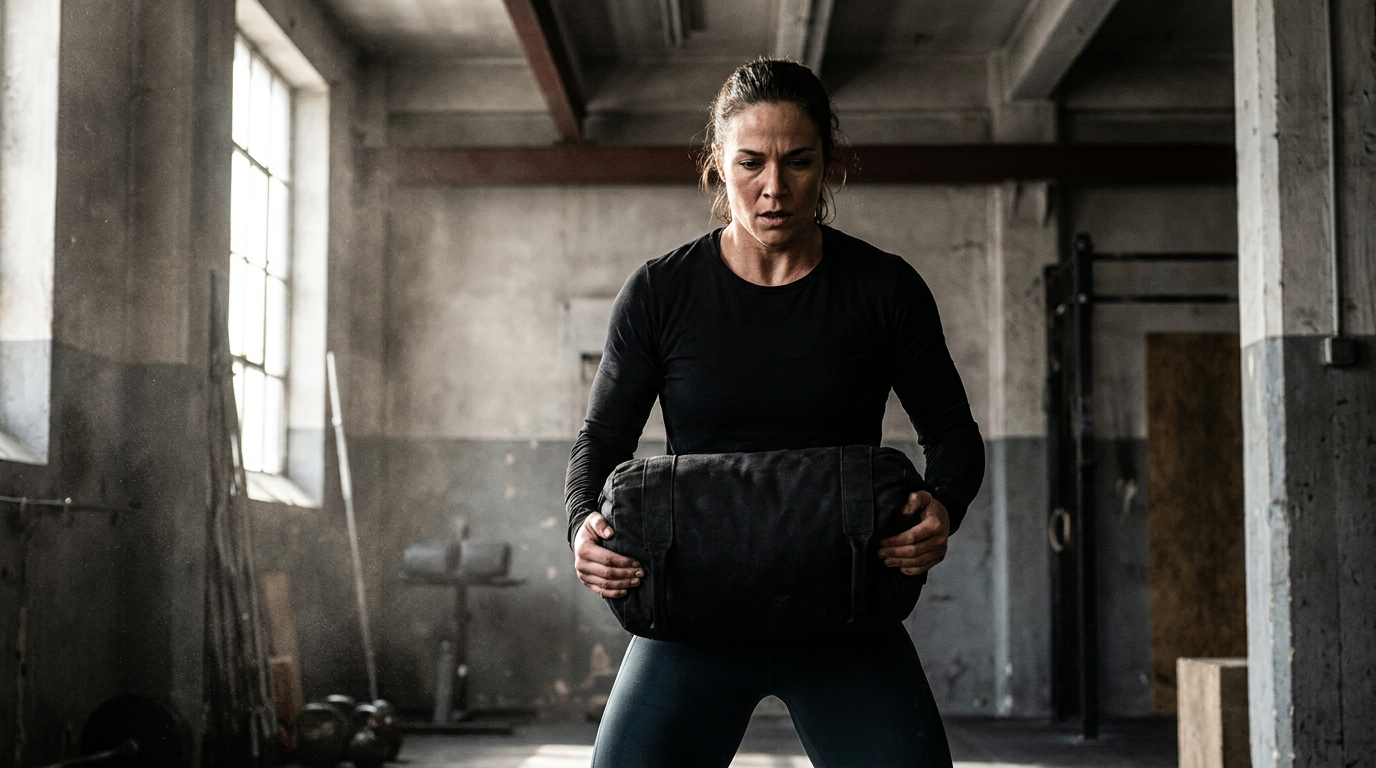
These six movements are the backbone of the program below. For a deeper movement library with technique detail on every lift, see our complete sandbag exercises guide. This post focuses on how to program them into a week of training.
1. Bear Hug Squat
Wrap both arms around the bag, crush it to your chest, and squat. The bear hug position hammers your upper back and forces upright posture. Aim for 3 to 4 sets of 8 to 12 reps.
2. Sandbag Clean
Pull the bag from the floor to your chest in one aggressive movement. Sandbag cleans build hip power and teach you to absorb load, which is exactly what obstacle courses and combat fitness tests demand. Keep sets short and explosive: 5 sets of 3 to 5 reps.
3. Shoulder Carry
Shoulder the bag and walk 40 to 80 meters, then switch sides. Uneven loading trains the obliques and hips hard. For a deeper dive into carry variations, see our full sandbag carry workout guide.
4. Front-Loaded Lunge
Hold the bag in the bear hug or front rack position and lunge. This torches the quads and challenges balance far more than dumbbells at your sides. Do 3 sets of 10 to 16 total steps.
5. Bent-Over Row
Grab the bag by the shell or handles and row it to your stomach. The thick, shifting grip builds forearm and upper back strength together. Go 3 to 4 sets of 8 to 10 reps.
6. Ground-to-Shoulder
Deadlift, clean, and shoulder the bag in one continuous fight. This is the most complete single movement in sandbag training and a brutal conditioning finisher. Try every minute on the minute for 8 to 10 minutes, 2 to 3 reps per side.

Start Here
The Skirmish Training Sandbag
Adjustable from 20 to 40 lbs, made in the USA, and built for every movement in this plan, $89.
Shop now →A 4-Week Full-Body Sandbag Plan
Train three days per week with at least one rest day between sessions. Add a weekly ruck or run to round out your conditioning, and if you are prepping for a specific branch test, check your target numbers with our free military PT calculators.
Day 1: Strength
Bear hug squat 4x8, bent-over row 4x8, front-loaded lunge 3x12 steps, plank 3x45 seconds. Add a rep each week.
Day 2: Power and Carries
Sandbag clean 5x3, shoulder carry 6x40 meters alternating sides, push-ups 4x max reps minus two. Add distance each week.
Day 3: Conditioning
Ground-to-shoulder EMOM for 10 minutes, then 3 rounds of 10 bear hug squats and a 100 meter carry for time. Rest, then finish with an easy 20 minute ruck or jog. Our ruck march training plan pairs perfectly with this day.
Week 4 is a deload: cut volume roughly in half, keep the movements crisp, and retest a benchmark like max ground-to-shoulders in 5 minutes.
How Heavy Should Your Sandbag Be?
Start lighter than your ego wants. A shifting 40 pound bag feels heavier than a 60 pound barbell. Most athletes do best starting between 20 and 40 pounds for skill work and conditioning, then moving to 60 to 80 pounds for strength work, carries, and ruck prep once technique is solid. Because good sandbags use adjustable filler bags, you can scale the same shell up as you get stronger instead of buying new equipment.

Ready to Go Heavy
The Raider Training Sandbag Kit
60 to 80 lbs of shifting load for serious strength work, carries, and selection prep, $139.97.
Shop now →Sandbag Workout FAQ
Can I build muscle with just a sandbag?
Yes. Progressive overload is progressive overload. Add reps, add weight to the filler bags, slow the tempo, or shorten rest periods. The shifting load also recruits stabilizers that machines and barbells miss.
Is sandbag training good for military prep?
It is one of the best tools available. Cleans, carries, and drags mirror combat fitness test events and selection course demands. Combine this plan with our military fitness test roadmap and track your scores with the free PT calculators.
How often should I train with a sandbag?
Two to four sessions per week works for most athletes. Because sandbag work is lower-skill and joint-friendly compared to heavy barbell lifts, recovery tends to be faster, but respect the same rules: hard days followed by easier days.
Sandbag vs barbell: which is better?
Neither replaces the other. Barbells are better for maximal strength because the load is stable and measurable. Sandbags are better for real-world strength, grip, and conditioning. The strongest hybrid athletes use both.