
How to Max Your Air Force PT Test: A Complete Training Guide

The Air Force PT Test is four events, 100 points each, with a max score of 100 after a weighted composite formula. It looks straightforward on paper. In practice, most Airmen leave points on the table because they train generally instead of training specifically for what the test measures. This guide covers each event, what the max scores look like, and a training approach that builds all four at once.
Use the Air Force PT calculator to run your current numbers and find exactly what scores you need to reach your target composite.
Want to see how the Air Force test compares to the Marine Corps, Army, Navy, and Coast Guard standards? Read our military fitness test comparison.
What the Air Force PT Test Measures
The AFPT tests four components, each weighted differently in the composite score:
- Aerobic component (60% weight): 1.5-mile run. This is the biggest driver of your composite score. A strong run covers a lot of ground.
- Push-ups (20% weight): Max reps in one minute. No rest during the set.
- Sit-ups (20% weight): Max reps in one minute. Hands behind the head, full sit-up each rep.
- Abdominal circumference: Measured at the natural waist. Exceeding limits results in a failing composite regardless of event scores.
The run is worth three times as much as either strength event. If you are pressed for training time, prioritize the 1.5-mile run above everything else.
Event 1: The 1.5-Mile Run
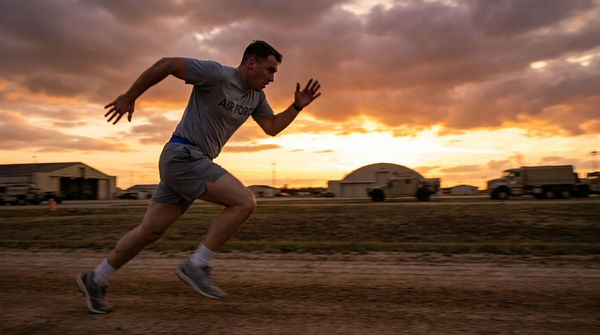
The run is the highest-leverage event on the AFPT. A max score for males aged 25-29 requires a sub-9:12. For females in the same bracket, sub-10:51. These are fast times that demand genuine aerobic development, not just occasional jogging.
Build the base first. Two to three easy runs per week at a conversational pace build the aerobic engine that supports fast race times. If you are currently running above 11:00, spend four weeks on easy mileage only before adding any speed work.
Add intervals once your base is solid. A simple interval session: 6 x 400m at your goal mile pace with 60-90 seconds rest. Do this once a week. It trains your body to maintain race speed without the wear of doing all your running at race effort.
Tempo runs close the gap. One tempo run per week at your goal 1.5-mile race pace for 10-15 minutes teaches your body to sustain that speed. This is harder than easy pace but not a full race effort. It is the bridge between base fitness and test-day performance.
Event 2: Push-Ups
Push-up scores for a max composite require 67 reps in one minute for males aged 25-29 and 42 for females. These numbers are achievable with consistent training, but most people train them wrong.
Sub-failure volume beats failure sets. Doing push-ups to failure once a day does not build the endurance needed for 60+ reps. Three to five sets at 50-60% of your max, spread across the day, produces faster gains. This grease-the-groove approach builds sustainable endurance without burning out your shoulders.
Pace training matters. On test day you have 60 seconds. Practice doing sets at a pace that lets you hit your target without hitting a wall at rep 50. Going out at max speed and dying at rep 40 is a predictable failure pattern. Know your sustainable pace before you test.
Accessory work: Tricep dips, close-grip push-ups, and resistance band push-ups build the specific muscles that support high-rep push-up performance. The Battle Bunker Battle Bands are useful here for adding resistance to bodyweight work without needing a gym.
Event 3: Sit-Ups
Sit-ups in the AFPT are a full range of motion, hands behind the head, one rep per smooth controlled movement. Sloppy technique and momentum-based reps cost you in official testing when graders enforce standards strictly.
Train the standard, not a variation. Practice the exact AFPT sit-up form in your training. Your hands stay behind your head, elbows move toward your knees, you go all the way down each rep. Training a modified version and then adjusting on test day costs you reps.
Volume approach: Same principle as push-ups. Multiple sub-failure sets throughout the day build more endurance than one max set per day. Add plank variations and leg raises to build the deeper core strength that makes high-rep sit-ups feel easier.
Abdominal Circumference
The waist measurement is the only component that can fail you regardless of how well you perform on the four scored events. It is measured at the natural waist, not the belly button. A single measurement over the limit results in a failing test.
This is not a training issue as much as a nutrition and body composition issue. If waist circumference is a concern, address your diet and overall conditioning program. No exercise alone changes this reliably without dietary changes to match.
8-Week AFPT Training Plan
- Monday: Push-up volume (3-5 sets at 50-60% max), Easy 25-min run
- Tuesday: Sit-up volume, Core circuit (planks, leg raises)
- Wednesday: 6 x 400m intervals at goal run pace
- Thursday: Push-up and sit-up volume, Light core work
- Friday: Tempo run (15 min at goal race pace)
- Saturday: Long easy run (30-40 min), Push-up pace sets
- Sunday: Rest
In weeks 5-8, increase run intensity by shortening rest on intervals and extending tempo run duration. Add one full mock test in week 6 and check your composite in the AF PT Test Calculator.
Common AFPT Mistakes
Undertrained run, overtrained push-ups. Because the run is worth 60% of the composite, 10 seconds off your run time is worth more than 5 extra push-up reps. Prioritize accordingly.
Testing push-ups daily. Max-effort sets every day create cumulative shoulder and elbow fatigue that stalls progress. Sub-failure volume training produces faster results.
Ignoring the waist measurement. Airmen who train hard but carry extra abdominal circumference can fail despite strong scored events. Body composition is part of the standard.
Not knowing your composite score target. The AFPT uses a weighted composite. Run your numbers through the calculator so you know your current composite and what specific improvements move it the most.

Battle Bunker Battle Bands
Add resistance to push-ups, assist pull-up and dip training, and use for mobility work between runs. Built for the functional fitness demands of military PT prep.
Shop Battle BandsThe Bottom Line
The Air Force PT Test rewards aerobic fitness above everything else. If you want to improve your composite score, the fastest path is improving your 1.5-mile run time. Build push-up and sit-up endurance through consistent sub-failure volume, and make sure your waist measurement is not undercutting your scored performance.
Know your numbers before you start. Use the Air Force PT Test Calculator to get your current composite, identify your weakest component, and set targets that move your score in the right direction.